
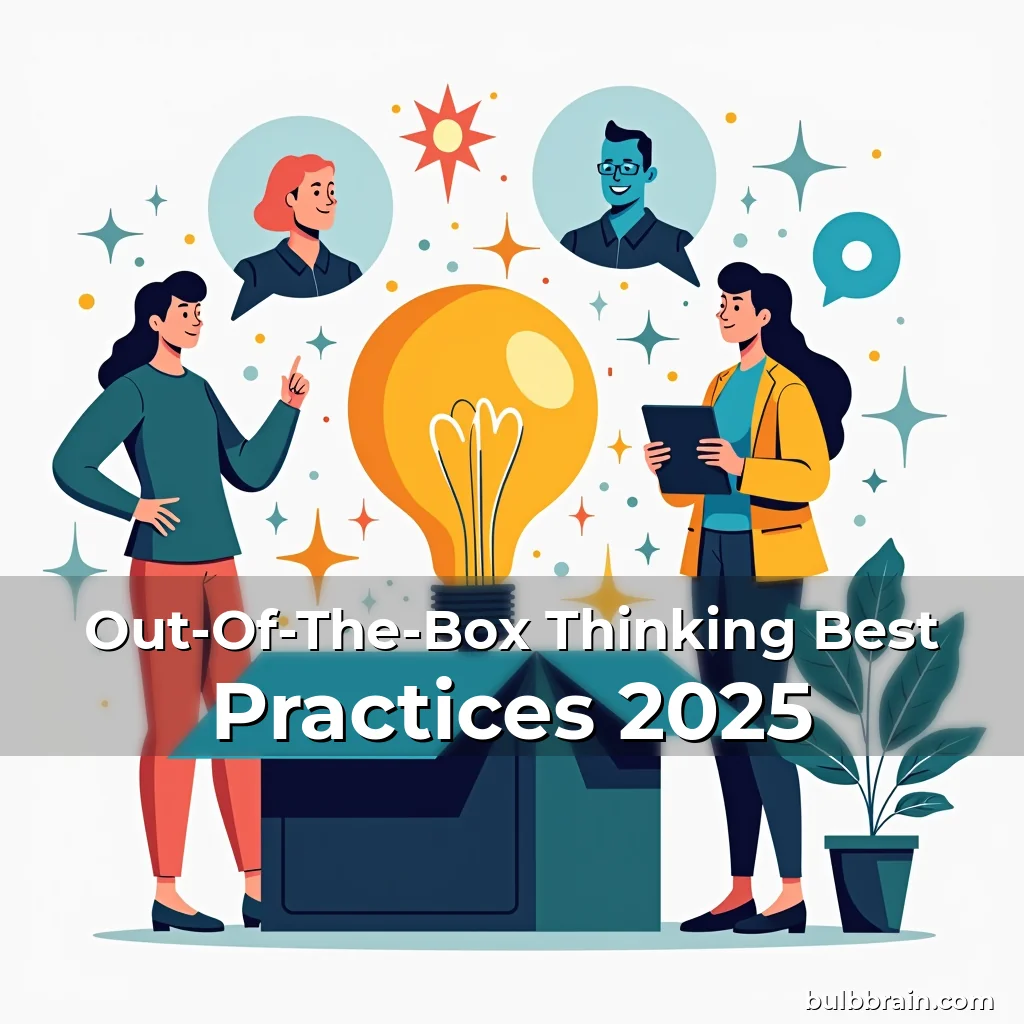
Out-Of-The-Box Thinking Best Practices 2025
In a world driven by rapid technological advancement and competitive markets, conventional solutions often fall short. Out-of-the-box thinking has emerged as a critical skill set for innovators, entrepreneurs, and professionals aiming to disrupt industries and redefine possibilities.
This guide explores cutting-edge strategies, real-world applications, and psychological frameworks that empower individuals to break free from cognitive biases and embrace radical creativity. Whether you’re solving complex problems or reimagining your career path, these insights will challenge your assumptions and ignite transformative change.
The Science Behind Unconventional Thought Processes
Cognitive neuroscience reveals that divergent thinking—the hallmark of creative breakthroughs—is linked to neural pathways that prioritize novelty over efficiency. This brain function declines during adolescence due to pruning processes but can be retrained through deliberate practice.
Research at MIT shows that experts who consistently innovate exhibit heightened activity in the default mode network, which activates during daydreaming and spontaneous ideation. This state allows connections between seemingly unrelated concepts, forming the basis of groundbreaking discoveries.
- Neuroplasticity: The brain’s ability to form new connections through repeated exposure to novel stimuli enhances creative capacity.
- Dopamine Regulation: Reward mechanisms associated with creative achievements reinforce risk-taking behaviors essential for disruptive innovation.
- Sleep Cycles: REM sleep stages facilitate memory consolidation and pattern recognition, both vital for synthesizing original ideas.
Historical Evolution of Creative Problem Solving
Human history is marked by pivotal moments where out-of-the-box thinking revolutionized society—from Archimedes’ principle of buoyancy to the invention of the printing press. These milestones demonstrate that paradigm-shifting ideas emerge when constraints are reframed as opportunities.
The Industrial Revolution exemplifies how challenging established norms accelerated progress. James Watt’s improvements to steam engines were born from questioning existing limitations rather than accepting them as immutable truths.
Pivotal Innovations Through Lateral Thinking
Data from the World Intellectual Property Organization indicates that 68% of patent filings since 2010 originated from cross-disciplinary collaborations. These cases highlight how merging disparate knowledge domains generates unprecedented solutions.
For instance, biomimicry—a field inspired by nature—has produced everything from self-cleaning surfaces modeled after lotus leaves to earthquake-resistant buildings designed after termite mounds. Such innovations require discarding linear approaches in favor of organic inspiration.
Modern Applications in Business Strategy
Tech giants like Google and IDEO have institutionalized creative methodologies to maintain competitiveness. Google’s famous “20% time” policy allowed engineers to pursue personal projects, leading to products like Gmail and AdSense.
Design thinking frameworks now dominate corporate innovation departments worldwide. Companies like Airbnb applied this approach to transform hotel booking into personalized travel experiences through empathetic design research and prototyping cycles.
- Blue Ocean Strategy: Creates uncontested market spaces by rendering competition irrelevant through value innovation.
- Rapid Prototyping: Enables quick testing of radical ideas before significant resource commitment.
- Ideation Sprints: Time-bound workshops focused on generating numerous viable concepts collaboratively.
Fostering Creativity in Everyday Life
Creative habits aren’t confined to professional settings—they permeate daily routines. Mindfulness practices enhance mental flexibility by reducing stress-induced rigidity that stifles innovative thought.
Keeping a curiosity journal forces intentional observation of mundane phenomena, cultivating awareness of patterns that might inspire unexpected solutions. Simple acts like changing routines or exploring new environments stimulate fresh perspectives.
Cognitive Biases Hindering Innovation
A study published in Nature Neuroscience found that people tend to rely on confirmation bias, filtering information through preexisting beliefs instead of evaluating novel data objectively. Overcoming this barrier requires conscious effort to seek contradictory evidence.
Anchoring effects also impede progress by fixating on initial information rather than reassessing based on new inputs. Techniques like reverse brainstorming—where participants identify ways to sabotage an idea—are effective countermeasures.
Technological Tools for Enhancing Creativity
Advancements in AI-assisted ideation platforms provide new avenues for creative exploration. Tools like Midjourney and DALL·E enable visual concept generation, allowing users to materialize abstract thoughts instantly.
Virtual reality environments offer immersive spaces for scenario simulation and spatial problem-solving. Architects using VR headsets report faster conceptualization times compared to traditional drafting methods.
- Brainstorming Software: Digital whiteboards like Miro support collaborative ideation across geographical locations.
- AI Prompt Engineering: Training machine learning models to understand nuanced human intent enhances generative outputs.
- Data Visualization Platforms: Convert raw datasets into intuitive formats revealing hidden correlations and insights.
Educational Frameworks Encouraging Radical Thinking
Montessori schools pioneered student-centered learning approaches that nurture intrinsic motivation and independent discovery. Their emphasis on hands-on experimentation aligns closely with modern pedagogical theories promoting creativity.
Project-based learning curricula integrate interdisciplinary themes, requiring students to solve open-ended challenges. Finland’s education system, ranked highest in global PISA assessments, incorporates substantial autonomy in learning paths.
Measuring Creative Impact Effectively
Traditional KPIs fail to capture intangible benefits of innovative thinking. Metrics like idea-to-product cycle time or customer satisfaction scores provide more meaningful insights into creative effectiveness.
Organizations implementing innovation dashboards track metrics such as percentage of revenue from new offerings or employee participation rates in ideation programs. These indicators correlate strongly with long-term growth trajectories.
Overcoming Organizational Resistance to Change
Culture plays a decisive role in whether creative initiatives thrive or falter. Research by Harvard Business Review shows that companies prioritizing psychological safety see threefold increases in risky proposals being implemented.
Leadership buy-in remains crucial despite growing emphasis on bottom-up innovation. When executives actively participate in ideation sessions, they signal organizational commitment to creative pursuits.
Future Trends in Disruptive Innovation
As quantum computing emerges, we may witness paradigm shifts in cryptography and optimization algorithms. Researchers are already exploring non-binary logic systems that defy classical computational limits.
Biotechnology advancements suggest upcoming revolutions in regenerative medicine and sustainable materials. CRISPR technology enables precise genetic editing previously unimaginable, opening ethical and practical debates about human enhancement.
- Metaverse Development: Virtual economies and digital twin technologies promise entirely new business models.
- Nanotechnology Breakthroughs: Molecular manufacturing capabilities approaching theoretical limits of material science.
- Artificial General Intelligence: Potential emergence of systems capable of autonomous creative problem-solving.
Building Personal Resilience for Continuous Innovation
Maintaining creative momentum requires emotional intelligence to navigate inevitable setbacks. Developing grit through consistent effort builds the perseverance necessary for long-term inventive success.
Growth mindset training helps individuals reinterpret failures as feedback loops rather than definitive outcomes. Celebrating incremental progress sustains motivation amid prolonged development cycles typical of disruptive innovations.
Conclusion
Out-of-the-box thinking is no longer optional—it’s imperative for navigating our increasingly complex world. By integrating scientific understanding, historical wisdom, and contemporary tools, we unlock unprecedented levels of creativity and problem-solving capability.
Start small by deliberately challenging assumptions in everyday situations. Document alternative perspectives systematically, and gradually expand your comfort zone with unorthodox approaches. Consistent application transforms occasional flashes of insight into sustained innovation capability.

news is a contributor at BulbBrain. We are committed to providing well-researched, accurate, and valuable content to our readers.
You May Also Like


About news
Passionate about learning, cognitive science, and helping people unlock their full potential.