
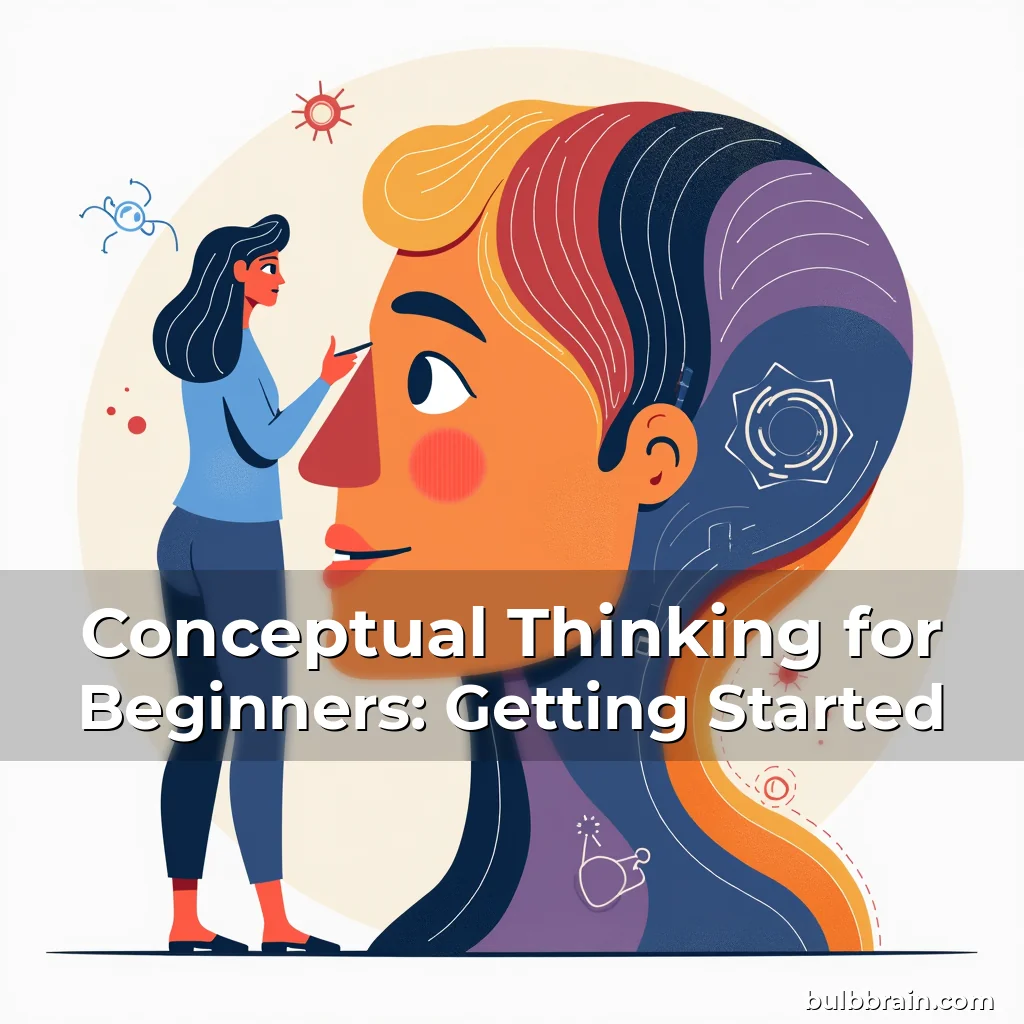
Conceptual Thinking for Beginners: Unleashing Creative Problem-Solving Potential
In an age where innovation drives progress, understanding and mastering conceptual thinking can transform your approach to problem-solving and decision-making. This powerful mindset allows individuals to see patterns,
In an era defined by rapid technological advancement and constant innovation, developing strong conceptual thinking skills has never been more important. This powerful mindset allows individuals to see patterns, establish connections, and create original solutions by focusing on underlying principles rather than surface-level details. Understanding how to apply conceptual thinking effectively transforms how we approach problems in every aspect of life.
Whether you’re navigating career challenges, tackling everyday puzzles, or exploring creative projects, cultivating conceptual thinking equips you with tools to think differently and more strategically. By learning how to extract meaning from complexity, you’ll discover new ways to interact with the world and develop a sharper sense of purpose in whatever path you choose.
What Exactly Is Conceptual Thinking?
At its core, conceptual thinking involves forming abstract representations of concrete realities. Instead of merely analyzing isolated facts, this approach looks for the bigger picture by examining how elements connect and influence each other. Think of it as the difference between memorizing formulas versus really understanding the mathematics behind them.
This kind of thinking goes beyond traditional analytical approaches by emphasizing imagination, synthesis, and holistic perception. While logical reasoning focuses on factual data and established rules, conceptual thinking explores possibilities through metaphorical frameworks and interdisciplinary connections that defy categorization.
Pattern recognition plays a crucial role in conceptual thinking. When scientists observe unusual weather patterns, artists notice visual motifs in nature, and business leaders detect market trends, they’re all exercising this fundamental skill. Identifying recurring themes across different domains opens doors to surprising revelations.
Albert Einstein famously used thought experiments to explore physics concepts that defied contemporary understanding. His imaginary ride along a light beam helped formulate his special theory of relativity – proof that bold conceptual leaps can lead to revolutionary insights.
- Cognitive flexibility: The ability to shift perspectives and consider situations from multiple angles improves conceptual processing capabilities significantly.
- Mental modeling: Creating internal representations of problems or scenarios enables exploration of alternative outcomes and better decision-making processes.
Foundational Elements of Effective Conceptual Thinking
To develop robust conceptual thinking skills, it’s essential to build strength in three key areas: creativity, critical analysis, and reflective observation. These complementary forces work synergistically to shape innovative thinking processes that can be applied in countless situations.
Creativity fuels the generation of novel ideas and unconventional associations. Critical analysis provides structure by evaluating ideas against evidence and logic. Reflective observation ensures we stay open to new perspectives and willing to revise existing assumptions when confronted with fresh information.
The Balance Between Divergent and Convergent Thinking
One of the most important dynamics in conceptual thinking is the balance between divergent and convergent thinking. Divergent thinking generates numerous potential solutions by exploring many possible directions simultaneously, like brainstorming sessions filled with wild ideas.
In contrast, convergent thinking narrows options systematically through evaluation criteria, much like solving a mathematical equation requiring precise steps toward a single answer. Mastering this dynamic interplay between free-flowing ideation and focused execution distinguishes effective concept generators from mere dreamers.
Studies show that professionals who regularly engage in both modes achieve superior results compared to those favoring one approach exclusively. Architects might first generate dozens of design sketches (divergent phase) then rigorously analyze structural feasibility (convergent phase), illustrating this principle perfectly.
The key lies in knowing when to prioritize which mode depending on context. During initial idea formation stages, allowing maximal divergence fosters breakthrough innovations. Later phases demand careful convergence to implement viable solutions grounded in reality checks and resource considerations.
Why Conceptual Thinking Matters Now More Than Ever
In rapidly changing environments marked by technological disruption and global interconnectedness, conceptual thinking has become more vital than ever. Companies seeking competitive advantage increasingly rely on employees capable of making meaningful connections across disciplines and contexts.
Consider Silicon Valley startups leveraging neuroscience research to improve user experience design, or healthcare organizations applying game theory principles to optimize treatment protocols. These cross-pollinations exemplify how conceptual thinkers drive transformative change by bridging diverse knowledge areas.
Educational institutions worldwide recognize this importance, integrating conceptual thinking training into curricula from early childhood education onwards. Finland’s top-ranked schools emphasize inquiry-based learning that cultivates exactly these kinds of flexible thinking capacities.
Moreover, as artificial intelligence continues advancing, humans retain irreplaceable roles precisely because of our uniquely developed capacity for conceptual reasoning. Machines may process vast datasets efficiently, but only humans possess the nuanced judgment required for ethical dilemmas, artistic expression, and complex interpersonal interactions.
Strategies for Developing Stronger Conceptual Thinking Skills
Developing strong conceptual thinking skills requires deliberate practice and conscious effort. Begin by creating habits that stimulate abstract thinking patterns and challenge conventional wisdom regularly. Engaging with philosophical texts offers excellent starting points for nurturing deeper conceptual awareness.
Keeping a conceptual thinking journal proves particularly beneficial. Dedicate time daily to record observations about patterns you encounter in life, relate them to previous entries, and explore potential implications. Over weeks and months, this habit trains your brain to look beneath superficial appearances consistently.
Practical exercises include:
- Engage with abstract art and music to train non-literal interpretation skills.
- Practice analogies by comparing unlike objects/things in unexpected ways.
- Spend time with experts in other fields to learn new conceptual frameworks.
An effective technique involves “mind mapping,” visually organizing ideas around central themes while drawing links between associated concepts. This spatial representation encourages seeing relationships that linear text might obscure.
Nurturing Cognitive Flexibility Through Daily Practices
Cognitive flexibility—the cornerstone of effective conceptual thinking—can be strengthened through targeted activities designed to stretch mental boundaries. One proven method involves playing strategy board games that require shifting tactics based on opponents’ moves.
Regularly switching tasks during work hours maintains mental agility by preventing habitual thought patterns from solidifying prematurely. Alternating between reading fiction and reviewing technical documents keeps neural pathways adaptable and receptive to varied information types.
Physical activity also plays a role in enhancing cognitive flexibility. Exercise increases blood flow to the prefrontal cortex, the brain region responsible for executive functioning and adaptive thinking. Even brief walks during study sessions have been shown to improve comprehension levels significantly.
Additionally, exposing yourself to multicultural experiences broadens perspective-taking abilities, another component of conceptual versatility. Learning basic phrases in foreign languages exposes learners to alternative worldview paradigms inherent in linguistic constructs themselves.
Real-World Applications of Conceptual Thinking
The beauty of conceptual thinking lies in its universal applicability across virtually any field of endeavor. In scientific research, it leads to paradigm-shifting hypotheses and theoretical breakthroughs that redefine entire disciplines.
Business strategists employ it to envision future markets, anticipate disruptive technologies, and construct resilient organizational architectures capable of thriving amidst uncertainty. Product designers use it to innovate interfaces that align seamlessly with human cognition patterns rather than forcing users to conform to arbitrary system requirements.
Some remarkable historical instances demonstrate its impact:
- Darwin’s theory of evolution emerged from observing natural selection patterns across species.
- Feynman diagrams simplified quantum mechanics complexities through elegant graphical representations.
- Design thinking methodologies originated from blending engineering logic with empathetic user research approaches.
These cases highlight how conceptual thinking bridges gaps between empirical observation and theoretical abstraction. Rather than being limited by existing frameworks, successful practitioners continuously question assumptions and seek unexplored connections between facts.
Common Obstacles in Conceptual Skill Development
Learning to think conceptually presents unique obstacles that require awareness and proactive strategies to overcome. Many people struggle initially due to

news is a contributor at BulbBrain. We are committed to providing well-researched, accurate, and valuable content to our readers.
You May Also Like


About news
Passionate about learning, cognitive science, and helping people unlock their full potential.