
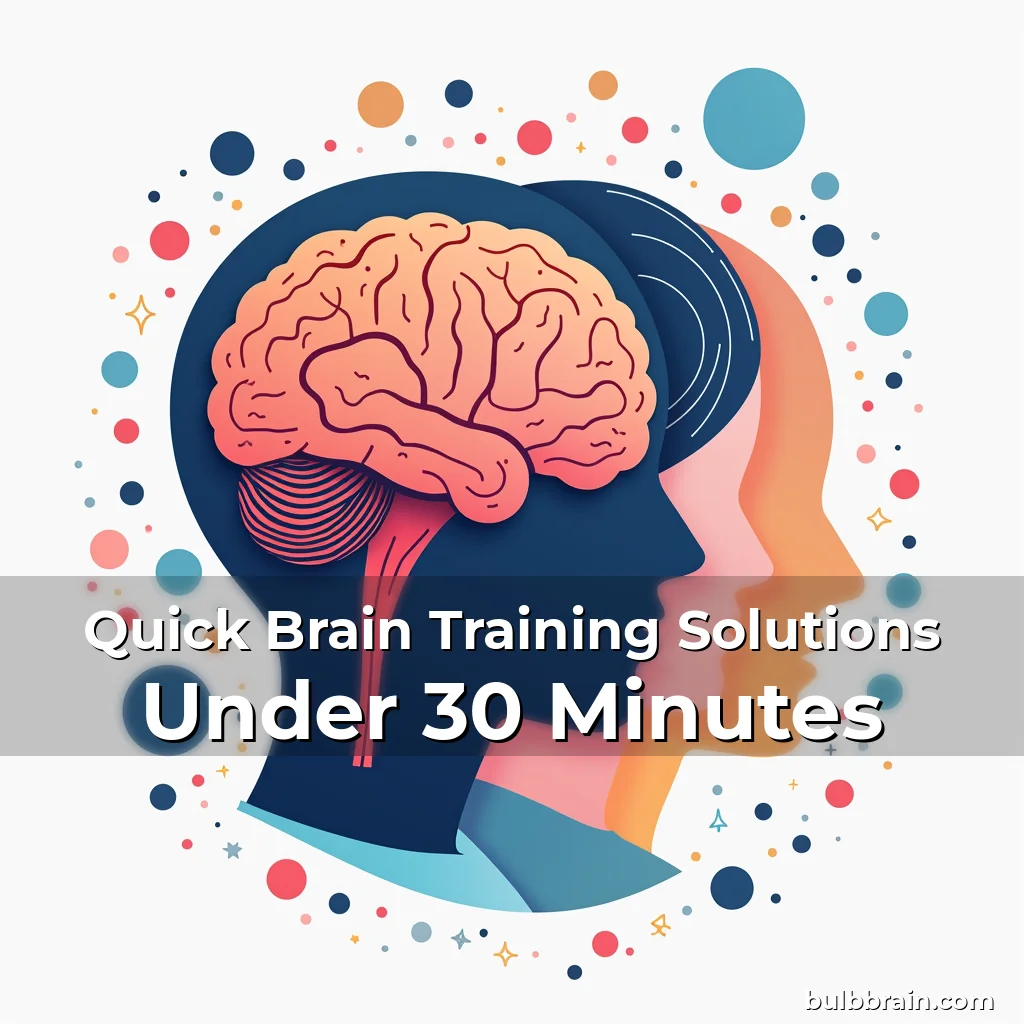
Quick Brain Training Solutions Under 30 Minutes
In today’s fast-paced world, finding time for brain training can feel overwhelming. However, effective mental exercises don’t require hours of commitment—they can fit seamlessly into your daily routine. Whether you’re looking to boost memory, enhance problem-solving skills, or simply stay mentally sharp, quick and efficient methods are available.
The key lies in consistency rather than duration. Short but focused sessions can yield significant cognitive benefits over time. By integrating simple strategies into your day, you can maintain mental agility without sacrificing productivity or leisure activities.
The Science Behind Quick Brain Training
Research has shown that brief, targeted mental workouts can stimulate neural plasticity—the brain’s ability to reorganize itself by forming new connections. This process is essential for learning, adapting, and maintaining cognitive function as we age.
Studies conducted at institutions such as Harvard University have demonstrated that even five minutes of daily mental exercise can lead to measurable improvements in attention span and working memory within weeks. These findings underscore the importance of regular engagement, regardless of session length.
Neuroscientists emphasize that the effectiveness of these exercises depends largely on their variety and challenge level. Repetitive tasks may not provide long-term benefits unless they evolve alongside your growing capabilities.
Engaging different areas of the brain through varied activities ensures sustained growth and prevents stagnation. For instance, alternating between mathematical puzzles and verbal fluency exercises promotes balanced development across cognitive domains.
- Cognitive Engagement: Activities that demand active participation, like solving riddles or playing strategy games, promote deeper neural activation compared to passive consumption of information.
- Variety in Tasks: Rotating between types of brain exercises helps prevent adaptation fatigue and keeps the mind engaged and curious.
- Immediate Feedback: Exercises that offer instant results—such as timed quizzes or interactive apps—help reinforce correct responses and encourage continuous improvement.
Daily Routines That Boost Mental Agility
A structured approach to brain training allows you to maximize efficiency while minimizing effort. Incorporating short, purposeful routines into your morning or evening schedule can create lasting habits that support cognitive health.
Morning rituals might include practicing mindfulness meditation or reciting vocabulary lists during your commute. Similarly, evening wind-downs could involve reading complex texts or engaging in light puzzle-solving before bed.
The most successful routines combine elements from various cognitive domains—memory, logic, creativity, and language—to ensure well-rounded mental stimulation. Balancing these aspects prevents burnout and maintains interest over extended periods.
Scheduling specific times each day dedicated solely to brain exercises fosters discipline and accountability. This habit reinforces the notion that mental fitness is just as crucial as physical wellness.
Sample Daily Routine Structure
A typical day might begin with a ten-minute guided meditation session followed by an eight-minute vocabulary drill using flashcards. Midday could feature fifteen minutes of strategic board game play or online chess challenges.
Evening activities might consist of twenty minutes spent solving crosswords or Sudoku puzzles, paired with listening to educational podcasts during dinner preparation. Consistency in timing helps establish strong associations between certain hours and mental exertion.
This structure encourages compartmentalization of cognitive workloads throughout the day, preventing exhaustion and ensuring steady progress toward improved mental acuity.
Adjustments based on personal preferences and lifestyle changes will determine which components remain consistent versus those requiring modification. Flexibility remains vital when establishing sustainable routines.
Effective Techniques Within Five Minutes
For individuals with extremely limited time availability, micro-exercises designed specifically for rapid implementation prove invaluable. These techniques often leverage existing environments or situations where minimal setup is required.
One popular method involves utilizing waiting periods—for example, memorizing license plate numbers while stopped at traffic lights or rehearsing multiplication tables aloud during bathroom visits. Such opportunistic approaches capitalize on otherwise idle moments.
Similarly, incorporating mnemonic devices into everyday conversations enhances retention capacity without demanding extra effort. Phrases constructed around familiar patterns aid recall significantly when practiced consistently.
Another technique includes performing quick arithmetic calculations mentally instead of relying on calculators whenever possible. Engaging basic math functions regularly strengthens numerical processing abilities effortlessly.
- Opportunistic Learning: Making use of natural pauses in daily life transforms mundane events into productive mental exercises.
- Mnemonic Integration: Embedding memory aids naturally within spoken interactions increases familiarity and ease of application.
- Calculation Practice: Regularly engaging in mental math boosts confidence and proficiency without formal study sessions.
Leveraging Technology for Cognitive Enhancement
Modern technology provides powerful tools tailored explicitly towards enhancing cognitive performance efficiently. Mobile applications, digital platforms, and wearable gadgets now enable personalized brain training regimens adaptable to individual schedules and goals.
Apps like Lumosity and Peak offer scientifically validated programs focusing on improving concentration, reaction speed, and logical reasoning through gamified formats. Their adaptive algorithms adjust difficulty levels dynamically according to user progress.
Smartwatches equipped with cognitive tracking features monitor metrics such as response times and decision-making accuracy. These data points help users identify strengths and weaknesses objectively.
Virtual reality systems also contribute positively by simulating immersive scenarios that test spatial awareness and multitasking capabilities under pressure. These experiences closely mimic real-life situations, making them highly relevant for practical skill development.
- Adaptive Algorithms: Apps modify question complexity automatically based on past performance, ensuring optimal challenge levels continually.
- Data Analytics: Tracking cognitive metrics enables informed decisions regarding training intensity and frequency adjustments.
- Immersive Experiences: Virtual environments replicate authentic conditions that refine critical thinking and situational adaptability effectively.
Nutritional Strategies Supporting Brain Health
Optimal brain functioning relies heavily on nutritional intake. Certain foods contain compounds known to nourish neurons, reduce inflammation, and protect against oxidative stress associated with aging processes.
Foods rich in omega-3 fatty acids, particularly EPA and DHA found abundantly in fish like salmon and mackerel, play crucial roles in preserving synaptic integrity and promoting neurogenesis.
Antioxidant-rich berries—including blueberries, strawberries, and raspberries—are linked to enhanced memory formation due to their high flavonoid content which improves blood flow to the hippocampus region responsible for memory consolidation.
Dark chocolate containing cocoa solids stimulates endorphin release and enhances mood stability indirectly contributing to better cognitive performance by reducing anxiety levels typically detrimental to focus.
- Omega-3 Fatty Acids: Found primarily in cold-water fish species; support neuronal communication and structural maintenance.
- Berries: Contain antioxidants that facilitate improved cerebral circulation necessary for efficient information processing.
- Cocoa Solids: Stimulate dopamine production thereby increasing motivation and alertness conducive to prolonged concentration spans.
Social Interaction as Cognitive Exercise
Human interaction presents another dimension worth exploring in relation to cognitive enhancement. Conversations, collaborative projects, and group discussions engage higher-order thinking processes beyond what solitary studies achieve alone.
Participating in debates or public speaking engagements activates regions involved in executive control mechanisms including inhibition, monitoring, and switching between tasks—all fundamental aspects of cognitive flexibility.
Group problem-solving activities foster divergent thinking patterns encouraging exploration of alternative solutions rather than adhering strictly to conventional wisdom paths.
Regular social contact reduces feelings of isolation correlated negatively with cognitive decline later in life suggesting its protective role extends beyond mere intellectual stimulation.
- Executive Function Activation: Social exchanges trigger complex thought processes involving self-regulation and perspective-taking skills.
- Divergent Thinking Promotion: Collaborative settings encourage innovative ideation unattainable through independent reflection alone.
- Isolation Reduction: Maintaining active interpersonal relationships mitigates risks associated with loneliness impacting overall mental vitality adversely.
Mindfulness Practices Enhancing Focus & Clarity
Mindfulness-based interventions demonstrate efficacy in sharpening attentional capacities and diminishing intrusive thoughts interfering with task completion efficiency. Techniques rooted in Buddhist traditions have been adapted successfully within contemporary psychological frameworks.
Practicing mindful breathing focuses conscious awareness entirely onto breath movements cultivating heightened sensory perception useful for identifying distractions promptly during any given activity.
Gestural mindfulness exercises involving body scan meditations increase proprioceptive awareness allowing greater control over motor coordination aspects pertinent to fine-tuned manual dexterity requirements encountered frequently across professions.
Integrating momentary pauses throughout busy schedules facilitates resetting cognitive resources periodically preventing mental fatigue accumulation leading up to potential errors or lapses in judgment.
- Attention Regulation: Mindfulness trains selective attention filters distinguishing meaningful stimuli from background noise efficiently.
- Sensory Awareness: Breathing-focused practices heighten receptivity enabling quicker recognition of environmental cues influencing behavior choices.
- Error Prevention: Scheduled rest intervals interrupt automatic pilot mode reducing chances of overlooking critical details embedded within larger contexts.
Physical Activity Complementing Mental Stimulation
Combining aerobic exercise with mental challenges creates synergistic effects amplifying both physical endurance and cognitive resilience simultaneously. Physical movement oxygenates the brain delivering essential nutrients facilitating cellular repair and renewal processes.
Activities such as brisk walking, cycling, or swimming elevate heart rates sufficiently to prompt increased glucose metabolism supporting energy demands placed upon neural networks actively engaged during concurrent mental tasks.
Yoga combines controlled breathing sequences with postural alignment corrections offering dual benefits addressing muscular tension relief along with mental clarity enhancements resulting from synchronized physiological rhythms.
High-intensity interval training (HIIT) protocols interspersed strategically amidst cognitive load episodes provide periodic surges of adrenaline that temporarily elevate alertness states beneficial for tackling difficult problems requiring peak concentration levels.
- Oxygen Delivery: Cardiovascular workouts enhance cerebral perfusion supplying adequate fuel sources sustaining prolonged mental exertion safely.
- Glucose Metabolism: Elevated cardiac output accelerates nutrient transport speeds crucial for maintaining stable brain function amid intense mental strain.
- Stress Hormone Modulation: Interval training regulates cortisol secretion helping manage emotional volatility impediments to clear thinking processes.
Evaluating Progress Through Self-Assessment Tools
Monitoring personal achievements objectively requires employing standardized evaluation instruments capable of quantifying cognitive gains accurately over specified timelines. These assessments serve dual purposes—tracking developmental trajectories and adjusting methodologies accordingly.
Standardized tests measuring fluid intelligence scores reflect improvements in abstract reasoning abilities indicative of expanded analytical prowess developed via persistent practice efforts.
Memory recall benchmarks established initially then reassessed after several months reveal tangible evidence validating efficacy of adopted strategies aligning expected outcomes with actual results achieved.
Anecdotal reports supplemented by empirical measurements form holistic pictures capturing multifaceted nature of cognitive evolution encompassing diverse facets ranging from linguistic competence to visuospatial aptitude.
- Fluid Intelligence Metrics: Assessments gauge ability to solve novel problems reflecting underlying conceptual understanding depths attained through rigorous training.
- Recall Proficiency Indicators: Periodic evaluations track memory retention curves illustrating how well acquired knowledge persists over varying durations.
- Comprehensive Skill Inventories: Multidimensional surveys assess proficiency ranges spanning multiple cognitive spheres providing panoramic views of overall brain functionality status quo.
Conclusion
Brain training need not consume vast amounts of time or resources—it can thrive within constrained parameters provided appropriate techniques are selected judiciously. Strategic integration of varied modalities ensures maximal benefit extraction from every invested minute.
By embracing science-backed approaches supported by technological advancements combined with healthy living principles, anyone seeking sharper cognition finds viable pathways forward irrespective of current circumstances limiting traditional study options traditionally perceived necessary for substantial mental gains.

news is a contributor at BulbBrain. We are committed to providing well-researched, accurate, and valuable content to our readers.
You May Also Like

About news
Passionate about learning, cognitive science, and helping people unlock their full potential.