
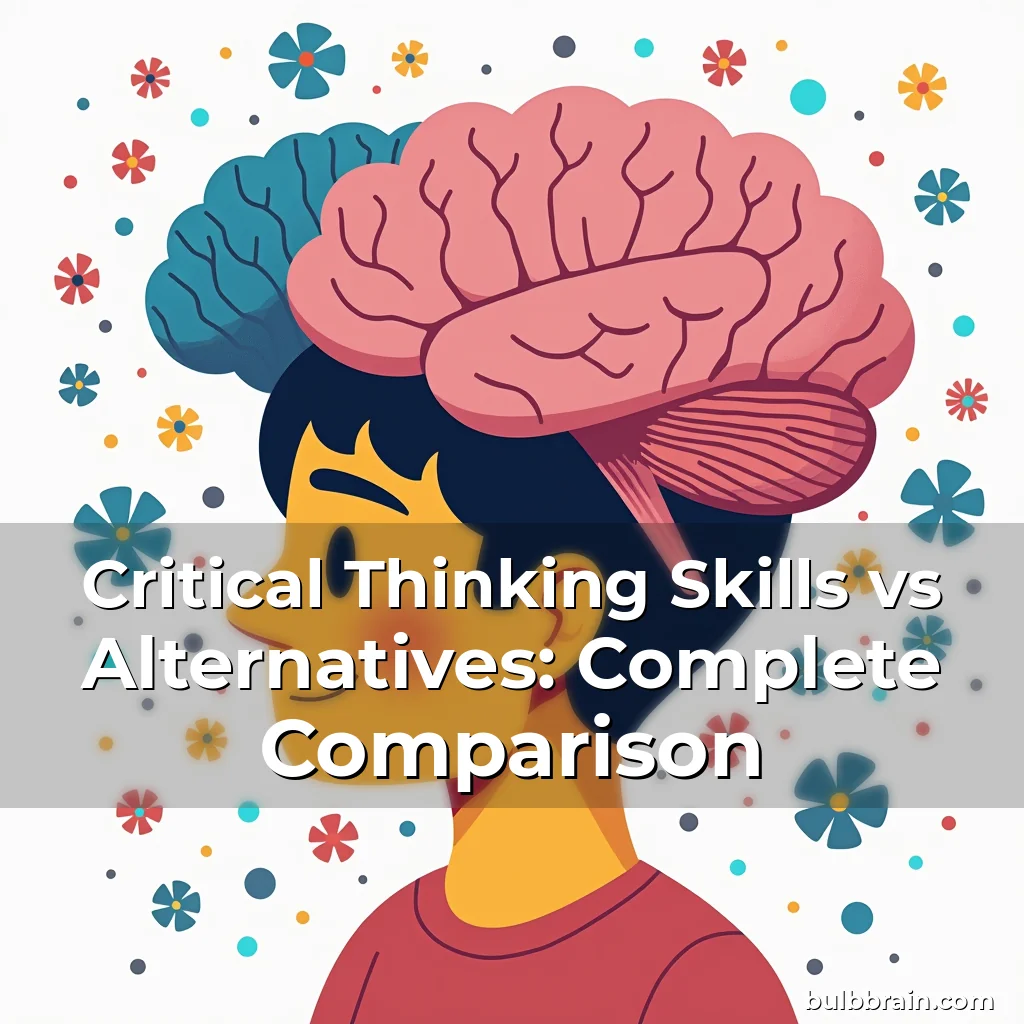
Critical Thinking Skills vs Alternatives: Complete Comparison
In today’s fast-paced world, the ability to think critically isn’t just a skill—it’s a necessity. Whether making personal decisions, solving complex problems, or navigating information overload, critical thinking provides clarity amid chaos.
This article delves deep into the essence of critical thinking, contrasting it with commonly confused counterparts like creative thinking, logical reasoning, and intuition. Through comparative analysis, we uncover why critical thinking stands apart and how mastering it transforms perspectives.
The Essence of Critical Thinking
Critical thinking involves evaluating facts, analyzing arguments, and forming reasoned judgments. It requires intellectual rigor and a commitment to seeking truth beyond surface-level appearances.
Unlike passive acceptance of information, critical thinking demands active questioning, scrutiny of assumptions, and synthesis of diverse viewpoints. These traits distinguish it from mere memorization or rote learning.
Cultivating critical thinking empowers individuals to discern credible evidence from misinformation, a vital skill in our era of digital disinformation. It forms the bedrock of informed decision-making across disciplines.
However, many confuse critical thinking with skepticism. While related, skepticism leans toward doubt without balance, whereas critical thinking integrates open-mindedness alongside rigorous inquiry.
- Evaluating Evidence: Critical thinkers assess sources for reliability, bias, and relevance before drawing conclusions.
- Analyzing Arguments: They dissect premises, identify fallacies, and test logical consistency in reasoning chains.
- Synthesizing Information: Combining disparate data points leads to holistic understanding rather than fragmented views.
- Reflective Judgment: Regular self-assessment ensures ongoing growth and refinement of analytical capabilities.
Differentiating Critical Thinking From Other Mental Processes
Logical reasoning focuses solely on formal structures and deductive validity. Yet, critical thinking encompasses both logical frameworks and broader contextual awareness.
While creativity thrives on innovation and divergent thought, critical thinking prioritizes convergence, refining ideas through systematic examination. Both are complementary but fundamentally distinct.
Emotional intelligence influences decision-making significantly; however, critical thinking aims to mitigate emotional biases through objective analysis. It doesn’t eliminate emotions but manages their impact.
Intuition plays a role in rapid judgment calls, yet lacks the methodical approach inherent to critical thinking. Intuitive responses often benefit from subsequent critical validation.
Common Confusions About Critical Thinking
A prevalent misconception equates critical thinking with negativity or pessimism. In reality, it promotes balanced inquiry and constructive critique rather than blanket criticism.
Some mistakenly believe critical thinking inhibits creativity. On the contrary, it enhances creative potential by enabling thoughtful exploration of possibilities instead of unfocused brainstorming.
Components of Effective Critical Thinking
At its core, critical thinking comprises five interrelated components: interpretation, analysis, evaluation, inference, and explanation. Mastery of these elements enables thorough problem-solving.
Interpretation involves decoding meaning from context, recognizing implicit messages, and identifying underlying motives behind communication.
Analysis requires breaking down complex systems into constituent parts. This allows identification of patterns, relationships, and causal factors influencing outcomes.
Evaluation centers on assessing credibility, accuracy, and significance of information. It entails weighing pros and cons while distinguishing fact from opinion.
Inference builds upon existing knowledge to form reasonable conjectures about unstated implications. This predictive capability informs strategic choices and risk assessments.
Explanation involves articulating reasoning clearly, connecting ideas logically, and presenting conclusions supported by sound evidence.
Critical Thinking Across Domains
In academia, strong critical thinking accelerates comprehension and retention of material. Students who actively question textbook assertions develop deeper conceptual grasp.
Professionals utilize critical thinking daily—from diagnosing technical issues to forecasting market trends. Its application translates into improved productivity and innovative solutions.
Personal development benefits immensely from cultivating critical thinking skills. Better financial management, healthier relationships, and wiser lifestyle choices stem from mindful reflection.
Governments and institutions increasingly value citizens capable of independent analysis. Such populations contribute positively to democratic discourse and policy formulation.
Educational Implications
Research indicates students taught critical thinking techniques score higher academically. A Stanford study found these learners demonstrated enhanced reading comprehension and analytical writing abilities.
Moreover, schools integrating critical thinking curricula report lower rates of academic fraud and plagiarism. Students internalize ethical responsibility through reflective practice.
Critical Thinking Versus Alternative Approaches
Compared to traditional education models emphasizing recall over understanding, critical thinking fosters lifelong learning capacities. Graduates retain knowledge better and adapt quickly to new contexts.
Rather than relying purely on experiential learning, critical thinking complements hands-on training with cognitive frameworks that enhance practical application effectiveness.
Contrasting with confirmation bias-driven thinking, critical thinkers deliberately seek opposing viewpoints. This exposure broadens perspective and mitigates echo chamber effects.
Where dogmatic belief systems resist change, critical thinking embraces revision based on emerging evidence. It embodies scientific methodology principles applied universally.
Barriers To Developing Strong Critical Thinking Skills
Cognitive biases pose significant obstacles to unbiased reasoning. Confirmation bias, availability heuristic, and anchoring effect distort perception of reality regularly.
Sociocultural influences shape thinking patterns early in life. Family values, religious teachings, and national ideologies mold interpretive lenses that may limit objectivity.
Lack of vocabulary impedes precise expression of thoughts. Limited lexical range hampers effective communication of nuanced positions during debates.
Distrust of institutions breeds cynicism rather than curiosity. Individuals skeptical of authority figures often abandon efforts at rational dialogue altogether.
Tech-Induced Challenges
Smartphone dependency reduces attention spans, impacting capacity for sustained concentration required for deep analysis. Constant notifications fragment mental processing continuity.
Algorithmic curation
Online forums cultivate respectful debate cultures. Structured discussion norms prevent derailments allowing focused exchange of ideas.
Game design incorporates branching narratives requiring player decision-making consequences. Interactive storytelling reinforces cause-effect reasoning through immersive experiences.
Conclusion
Critical thinking remains indispensable amidst increasing complexity facing contemporary societies. Its multifaceted nature offers advantages spanning personal empowerment to collective progress.
To thrive in tomorrow’s uncertain landscape, prioritize honing these vital competencies through conscious effort and continuous learning journeys tailored specifically towards cognitive enhancement goals.

news is a contributor at BulbBrain. We are committed to providing well-researched, accurate, and valuable content to our readers.
You May Also Like
About news
Passionate about learning, cognitive science, and helping people unlock their full potential.