
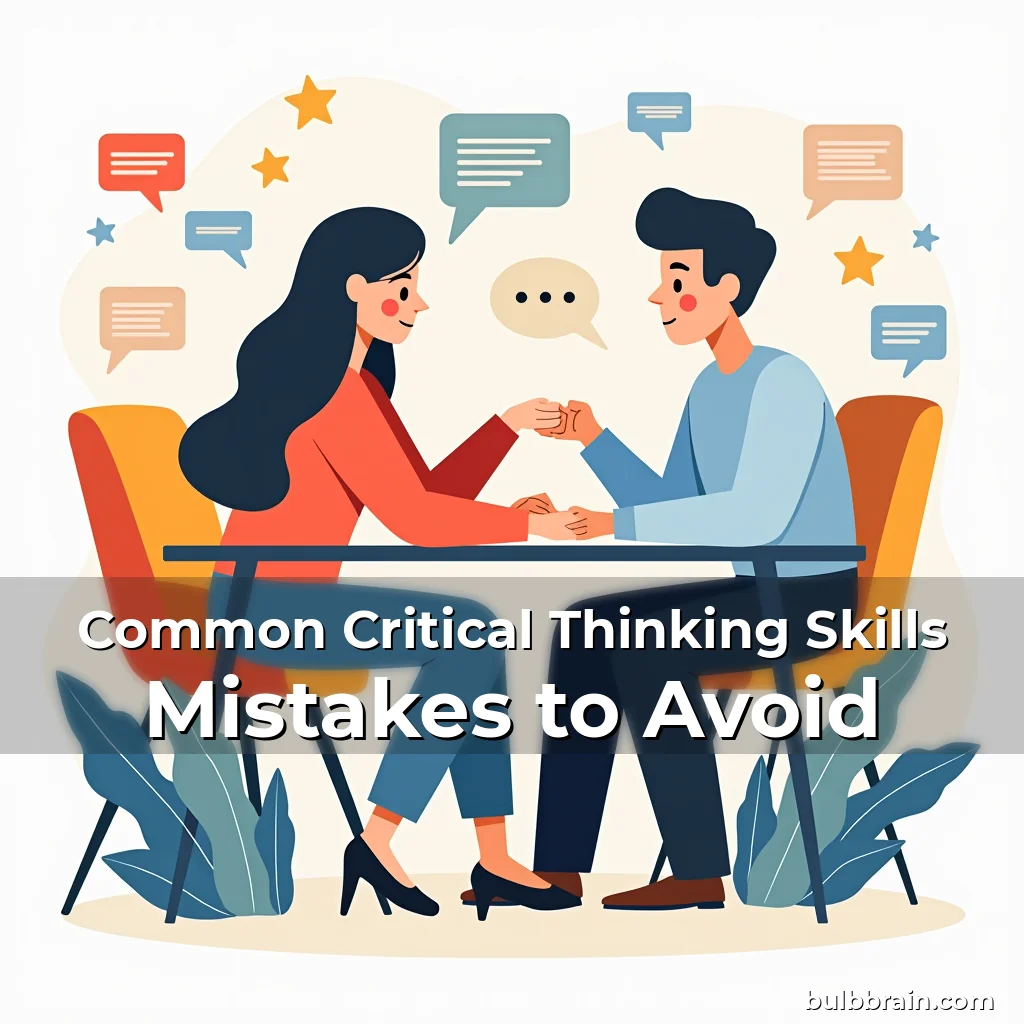
Common Critical Thinking Skills Mistakes to Avoid
Critical thinking is often viewed as an innate talent, but it’s actually a set of learnable skills that can be honed through practice and awareness. This article explores common pitfalls people face when developing these essential abilities.
Mistakes in critical thinking aren’t just academic oversights—they impact decision-making across personal and professional contexts. Understanding what goes wrong helps us correct course before flawed logic leads to poor outcomes.
The Myth of Natural Talent
A widespread misconception is that critical thinking ability is something you’re born with rather than something you develop over time. This belief creates a dangerous mindset where individuals stop trying once they feel their natural limits.
Research from cognitive psychology shows that while some people may start with slightly better analytical capabilities, everyone has the potential to significantly enhance their thinking patterns through deliberate effort.
The danger lies in believing you’ve reached your peak early on. Studies indicate that those who give up after initial struggles rarely reach the higher levels of complex problem-solving others achieve through persistence.
- Believing in fixed intelligence: This mindset prevents growth by making people avoid challenging tasks fearing failure reflects permanent lack of ability.
- Underestimating the power of practice: Like any skill, critical thinking improves with targeted exercises and reflection on past decisions.
Skip the Surface-Level Analysis
An insidious mistake many make is relying too heavily on first impressions without deeper investigation. This tendency often stems from cognitive biases that prioritize quick conclusions over thorough examination.
When faced with new information, our brains naturally seek patterns to simplify processing. However, this shortcut frequently leads to incorrect assumptions about facts we haven’t verified.
Data analysis professionals warn that jumping to conclusions based on incomplete data is among the most costly errors in business settings. A single miscalculation can lead to millions lost due to misguided strategies.
- Fallacy of composition: Assuming characteristics of individual parts apply universally to whole systems without verification.
- Confirmation bias: Seeking out only information that supports preexisting beliefs while ignoring contradictory evidence.
Overconfidence in Personal Opinions
One of the most damaging mistakes involves treating personal opinions as objective truths. This error manifests when people dismiss alternative viewpoints as invalid simply because they differ from established beliefs.
Psychologists refer to this phenomenon as “belief perseverance,” where individuals cling to ideas even after presented with clear counter-evidence. It creates intellectual stagnation by preventing meaningful dialogue.
In group discussions, this attitude stifles innovation by discouraging diverse perspectives. Teams dominated by rigid thinkers struggle to solve novel problems effectively.
- Dunning-Kruger effect: Beginners tend to overestimate competence while experts sometimes underestimate theirs relative to peers.
- Egocentric bias: Interpreting events primarily through self-centered lens rather than considering broader context.
Lack of Questioning Assumptions
Many fail to recognize how deeply ingrained assumptions shape their thinking processes. These unconscious premises often go unexamined despite influencing every judgment made daily.
Philosophers emphasize that questioning assumptions is foundational to logical reasoning. Without regularly revisiting core beliefs, we risk perpetuating flawed worldviews unknowingly.
For example, assuming market trends follow predictable cycles might lead investors to overlook disruptive innovations until it’s too late. Regularly auditing mental models helps identify such blind spots.
- Status quo bias: Preferring familiar options over potentially better alternatives merely because they’re known.
- Anchoring effect: Relying excessively on initial pieces of information when making subsequent judgments.
Failure to Consider Alternative Perspectives
Thinking within narrow frameworks limits our understanding of complex issues. When we ignore opposing viewpoints, we miss opportunities to refine our own positions through constructive debate.
Academic research consistently shows that exposure to differing opinions enhances cognitive flexibility. Engaging with contrary arguments strengthens position validity through rigorous testing.
Political polarization provides a stark example—those who refuse to listen to other sides become entrenched in extreme views lacking nuance or factual basis.
- Polarization trap: Allowing emotional reactions to dominate rational evaluation of opposing stances.
- Cognitive dissonance avoidance: Refusing to acknowledge contradictions between held beliefs and new information.
Neglecting Emotional Intelligence Components
Emotional regulation plays a crucial role in maintaining balanced thought processes. Individuals who cannot manage frustration or stress are prone to irrational conclusions under pressure.
Neuroscience reveals that heightened emotions activate brain regions associated with impulsive responses rather than reasoned deliberation. Recognizing this connection allows for better control over decision-making.
Practicing mindfulness techniques has been shown to improve emotional resilience. People who meditate regularly demonstrate greater capacity for sustained concentration during difficult analyses.
- Reactivity: Making snap judgments driven by immediate emotional impulses rather than considered analysis.
- Projection: Attributing one’s own thoughts or feelings onto others without sufficient evidence.
Ignoring the Role of Context
Contextual factors profoundly influence interpretation yet are commonly overlooked. Situational variables determine meaning in ways that conscious analysis alone cannot fully account for.
Historians caution against applying modern values to historical events without understanding prevailing attitudes at the time. Such anachronisms create misleading interpretations of past behaviors.
In legal proceedings, judges must consider cultural background when evaluating testimony. Failure to do so risks misinterpreting statements that appear incriminating but were culturally appropriate.
- Historical fallacy: Judging past actions using present-day standards without acknowledging different societal norms.
- Cultural myopia: Failing to appreciate nuances arising from distinct social environments and experiences.
Not Practicing Systematic Evaluation Techniques
Effective critical thinking requires structured methodologies rather than random introspection. Without formal approaches, evaluations remain inconsistent and unreliable.
Experts recommend using frameworks like SWOT analysis or Six Sigma principles to maintain objectivity. These tools provide standardized benchmarks for measuring strengths and weaknesses objectively.
Business leaders who employ systematic review processes report fewer strategic blunders compared to those relying solely on intuition. Structured analysis reduces variability in decision quality.
- SWOT framework: Evaluates Strengths, Weaknesses, Opportunities, Threats systematically to guide strategic choices.
- Root cause analysis: Identifies underlying causes rather than focusing only on surface-level symptoms.
Overlooking the Importance of Evidence Quality
Assessing the credibility of sources is fundamental yet frequently neglected. Many draw conclusions based on questionable evidence without scrutinizing its reliability.
Journalism training emphasizes verifying claims through multiple independent sources. Cross-referencing increases confidence in findings’ accuracy before drawing final conclusions.
Scientific studies highlight correlation-causation confusion as a persistent issue. Distinguishing between coincidental associations and genuine causal relationships remains notoriously tricky.
- Selection bias: Drawing conclusions from non-representative samples leading to skewed results.
- Publication bias: Overrepresentation of positive study outcomes in published literature distorting overall perception of effectiveness.
Concluding Thoughts on Cognitive Improvement
Recognizing these common pitfalls represents the first step toward stronger critical thinking abilities. Awareness alone isn’t enough however—it needs to translate into consistent action.
To build lasting improvements, incorporate regular practice routines focused on identifying and correcting these tendencies deliberately. Keep track of progress through reflective journaling or peer feedback mechanisms.
Engage with diverse communities and challenge yourself intellectually through reading materials outside comfort zones. Actively seeking discomfort promotes neurological adaptation necessary for enhanced cognition.
Remember that mastery takes years of dedicated work. Celebrate small victories along the way to stay motivated on this lifelong journey of discovery and refinement.

news is a contributor at BulbBrain. We are committed to providing well-researched, accurate, and valuable content to our readers.
You May Also Like

About news
Passionate about learning, cognitive science, and helping people unlock their full potential.