
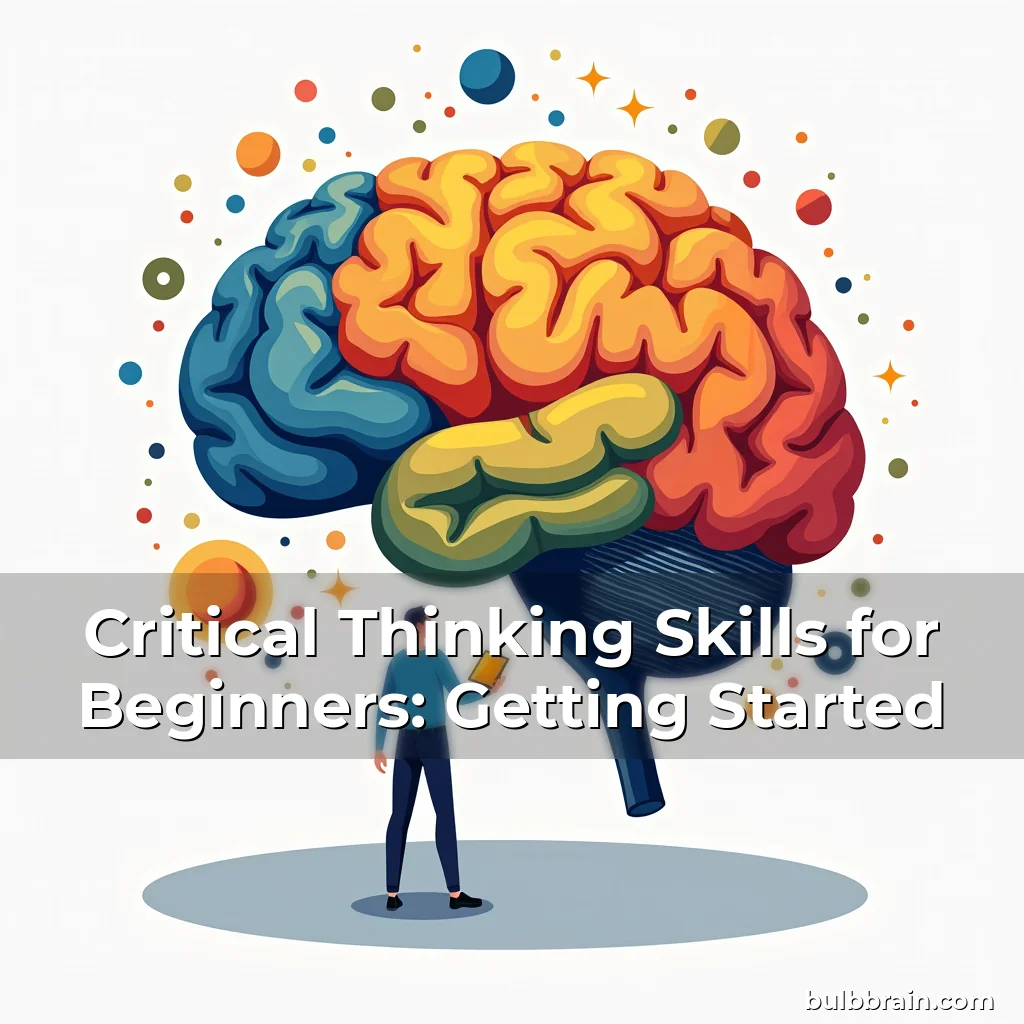
Critical Thinking Skills for Beginners: Mastering the Art of Logical Reasoning
In an era defined by information overload, critical thinking skills stand out as a vital tool for navigating complexity, solving problems, and making informed decisions. Whether you’re analyzing news headlines, evaluating scientific claims, or deciding on personal goals, the ability to think critically separates those who passively absorb data from those who actively engage with it. This guide is designed for beginners seeking to understand and develop these essential mental muscles.
Critical thinking isn’t just about intelligence—it’s a learned skill that involves curiosity, skepticism, and open-mindedness. By systematically applying frameworks like analysis, evaluation, and logical reasoning, anyone can sharpen their capacity to question assumptions, identify biases, and arrive at reasoned conclusions. Below, we explore how to begin building these skills step by step.
The Foundation of Critical Thinking: Understanding Its Core Principles
Critical thinking begins with recognizing the difference between facts and opinions. Facts are objective truths supported by evidence, whereas opinions reflect subjective interpretations influenced by emotions or experiences. Distinguishing between the two is the first step toward forming clear, rational judgments. For example, stating “Water boils at 100°C” is factual, while saying “Boiling water tastes better than cold water” is an opinion rooted in preference.
At its core, critical thinking requires intellectual humility—the willingness to acknowledge gaps in knowledge and challenge preconceived notions. This mindset encourages continuous learning rather than rigid adherence to familiar ideas. Studies show that individuals who embrace uncertainty tend to solve complex problems faster because they remain receptive to new possibilities.
- Evidence-based reasoning: Always ask, “What proof supports this claim?” Reliable arguments depend on credible sources and verifiable data.
- Suspension of judgment: Avoid jumping to conclusions by delaying responses until sufficient information is gathered. Rushed decisions often lead to errors.
- Analytical decomposition: Break down complex issues into smaller parts to examine causes, effects, and relationships more clearly.
Critical thinkers also prioritize relevance. Not all information contributes equally to a decision. Focusing on pertinent details prevents distractions caused by extraneous data. For instance, when assessing a medical treatment, factors like efficacy, safety, and cost matter most, while unrelated metrics like packaging color are irrelevant.
A key principle of critical thinking is identifying logical fallacies—inconsistencies in reasoning that undermine validity. Common examples include ad hominem attacks (“You’re wrong because you’re untrustworthy”) and false dilemmas (“Either support this policy or oppose freedom”). Recognizing these flaws allows you to dissect flawed arguments effectively.
Beyond Surface-Level Analysis: Developing Deeper Cognitive Habits
To elevate your critical thinking beyond basic analysis, cultivate habits that promote deeper engagement with information. One powerful strategy is asking probing questions. Instead of accepting statements at face value, inquire about underlying motivations, potential consequences, and alternative viewpoints. Questions like “Who benefits from this argument?” or “What assumptions are being made?” reveal hidden layers of meaning.
Active listening plays a crucial role in collaborative settings. When others share perspectives, listen without interrupting and mentally summarize their key points before responding. This practice reduces misunderstandings and fosters respectful dialogue, even when disagreements arise. Research indicates that teams practicing active listening achieve better problem-solving outcomes due to increased trust and transparency.
The Role of Metacognition in Enhancing Thought Processes
Metacognition—thinking about your own thinking—is a cornerstone of advanced critical thinking. Reflect regularly on how you approach problems, what biases influence your decisions, and whether your methods yield consistent results. Journaling after major decisions or debates can uncover patterns in reasoning, helping you refine ineffective strategies over time.
For instance, someone prone to confirmation bias might realize, through metacognitive reflection, that they habitually seek information confirming existing beliefs. Awareness alone doesn’t eliminate bias, but it
Understanding sponsored content is also crucial. Advertisements disguised as editorial pieces frequently omit disclosures, misleading audiences about product affiliations. Reading fine print and clicking through disclosure links clarifies conflicts of interest affecting objectivity.
Leverage digital literacy tools like Google Scholar for scholarly resources, NewsGuard to verify news outlet reputations, and browser extensions filtering misinformation. Regularly updating technical skills keeps pace with evolving online landscapes where new platforms emerge constantly.
Measuring Progress: Tracking Improvement in Critical Thinking
Assessing growth in critical thinking requires intentional effort. Maintain a journal documenting past decisions alongside reflections on what worked well and what could improve. Periodic reviews highlight trends indicating either steady enhancement or plateaus requiring renewed focus.
Formal assessments provide quantifiable benchmarks. Online quizzes evaluating logical reasoning, pattern recognition, and argument evaluation offer immediate feedback on strengths and weaknesses. Repeating these tests periodically shows progression over time.
- Track frequency of questioning: Note how often you pause to ask critical questions instead of accepting information uncritically.
- Monitor reaction speed to contradictions: Improved agility in addressing conflicting information suggests enhanced analytical flexibility.
- Count instances of evidence-based decisions: Increase in citing specific reasons rather than vague generalizations reflects deeper understanding.
Seek external validation through mentorship programs or workshops led by experienced practitioners. Engaging in group discussions exposes blind spots and reinforces skills through collective problem-solving. Feedback loops
Finally, accept that setbacks are natural parts of growth journeys. Missteps don’t signify failure—they represent valuable learning opportunities refining future approaches. Adopting a lifelong learner mindset shifts perceptions from perfectionism toward perpetual improvement.
Future Trends: How Technology Shapes Critical Thinking Evolution
Advancements in artificial intelligence and machine learning introduce new dimensions to critical thinking education. Interactive AI tutors personalize learning paths by diagnosing knowledge gaps and recommending tailored exercises. Virtual simulations allow safe experimentation with complex systems, accelerating hands-on experience acquisition.
Data analytics tools empower individuals to visualize information dynamically, revealing correlations invisible to human observers alone. Mapping socioeconomic indicators geographically, for instance, illuminates disparities obscured by static reports, prompting more insightful investigations into root causes.
- Augmented reality interfaces: Overlaying contextual information onto physical environments enhances situational awareness, aiding real-time decision-making accuracy.
- Collaborative problem-solving platforms: Global networks enable crowdsourcing expertise, combining varied perspectives to tackle multidisciplinary challenges efficiently.
- Neurofeedback devices: Monitor brainwave activity to optimize concentration states, improving efficiency during demanding analytical tasks.
Ethical considerations accompany technological advancements. Ensuring algorithm fairness, protecting data privacy, and preventing misinformation propagation become integral responsibilities for digitally savvy critical thinkers. Staying abreast of emerging regulations safeguards against misuse of powerful tools.
As automation handles routine tasks, higher-order thinking skills gain premium importance. Cultivating creativity, ethical judgment, and cross-cultural communication distinguishes humans from machines, positioning critical thinkers advantageously in rapidly transforming labor markets.
Conclusion
Critical thinking skills form the backbone of personal and professional success in our interconnected world. From deciphering political rhetoric to troubleshooting engineering designs, these competencies enable us to navigate ambiguity confidently and act decisively. Through systematic study, persistent practice, and wise technology utilization, anyone can master this art regardless of background or prior aptitudes.
To begin your journey, commit to daily self-reflection, adopt skeptical inquiry as a default mode, and surround yourself with intellectually stimulating materials. Remember, the goal isn’t achieving infallibility—but becoming increasingly adept at detecting and correcting errors in your own reasoning. With dedication, critical thinking evolves from abstract theory into transformative power shaping every aspect of your life positively.

news is a contributor at BulbBrain. We are committed to providing well-researched, accurate, and valuable content to our readers.
You May Also Like

About news
Passionate about learning, cognitive science, and helping people unlock their full potential.