
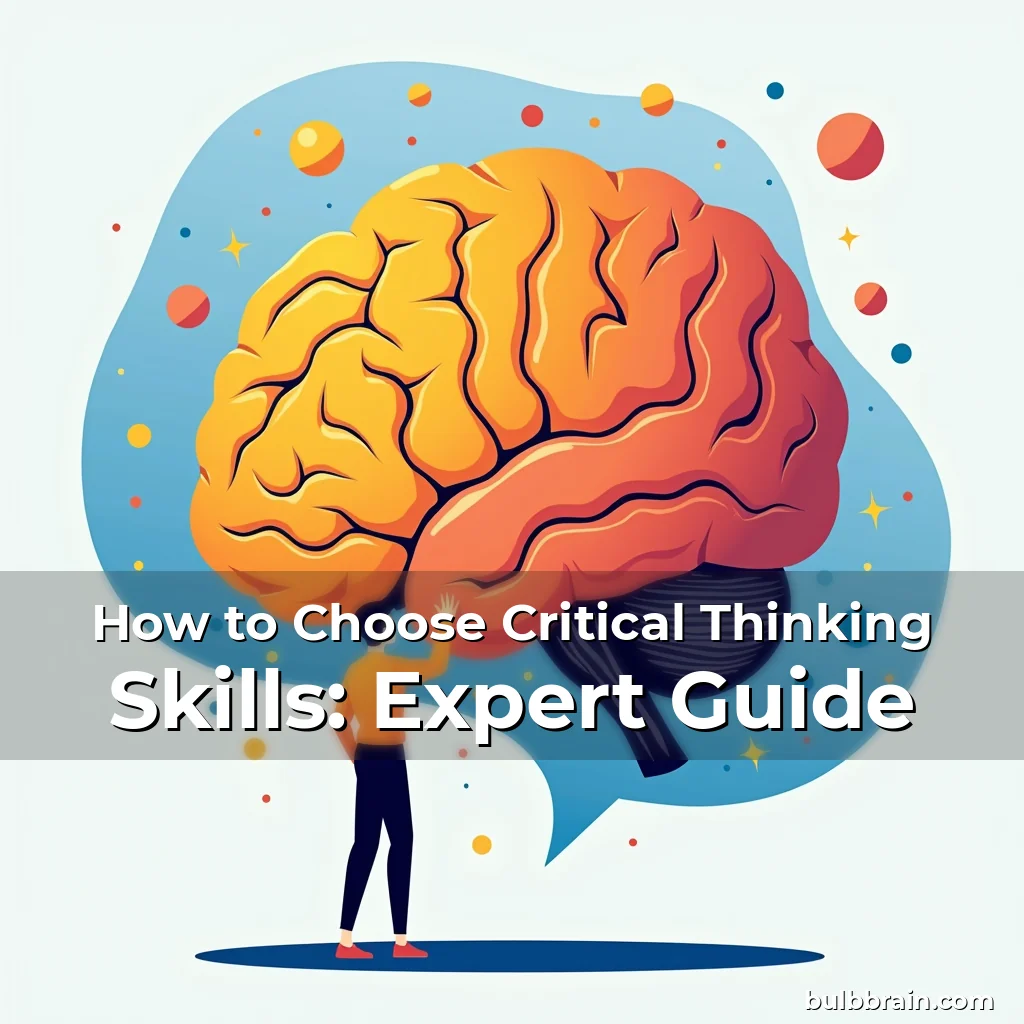
How to Choose Critical Thinking Skills: Expert Guide
Critical thinking is often described as the cornerstone of intellectual growth, yet many struggle to define exactly what it entails. This guide aims to clarify its essence while providing practical steps for developing these vital abilities.
In today’s information-saturated world, distinguishing between credible sources and misleading narratives has become essential. Mastering critical thinking equips individuals with tools to navigate complex decisions confidently.
The Foundation of Critical Thinking
Critical thinking begins with cultivating an open mind that questions assumptions rather than accepting them at face value. It involves examining evidence objectively without emotional bias.
This mindset allows individuals to approach problems systematically, weighing different perspectives before forming conclusions. Developing such habits requires conscious effort and practice over time.
One key aspect is recognizing cognitive biases that cloud judgment. These include confirmation bias, where people favor information aligning with preexisting beliefs.
By acknowledging these tendencies, learners can begin dismantling mental shortcuts that lead to flawed reasoning patterns.
Building Blocks of Analytical Reasoning
Analyzing information effectively starts with understanding basic logic structures. Identifying valid versus invalid arguments forms the basis for sound decision-making.
Familiarity with logical fallacies helps avoid common pitfalls. Examples include ad hominem attacks, which target a person instead of addressing their argument directly.
Recognizing these errors empowers individuals to engage more thoughtfully in debates and discussions across various contexts.
- Identify premises: Determine foundational statements supporting a conclusion.
- Evaluate validity: Assess whether the structure of an argument logically leads to its conclusion.
- Detect fallacies: Spot faulty reasoning techniques used to manipulate opinions.
Cultivating Intellectual Humility
Intellectual humility plays a crucial role in fostering genuine curiosity about diverse viewpoints. It acknowledges that no single perspective holds absolute truth.
This openness reduces defensiveness when encountering contradictory ideas, allowing for more constructive dialogue and learning opportunities.
Studies show that intellectually humble individuals are better equipped to adapt to new information and revise incorrect beliefs when presented with compelling evidence.
Maintaining this trait requires self-awareness and willingness to confront personal limitations regarding knowledge gaps.
Practical Strategies for Skill Development
Engaging regularly with challenging material stimulates neural pathways associated with analytical processing. Reading philosophical texts or scientific journals provides rich subject matter for reflection.
Solving puzzles or playing strategy games also enhances problem-solving capabilities by encouraging systematic approaches to complex situations.
Journaling thoughts after consuming media promotes metacognition—thinking about how we think—which strengthens reflective practices necessary for deep analysis.
Participating in structured debate clubs offers real-world application of critical evaluation techniques through direct engagement with opposing viewpoints.
Navigating Information Overload Effectively
In our digital age, sifting through vast amounts of data demands discernment. Learning to prioritize reliable sources becomes paramount in making informed choices daily.
Developing source verification skills includes checking author credentials, publication dates, and cross-referencing claims with independent research findings.
Critically evaluating visual content—such as infographics or videos—is equally important since non-textual formats can be misleadingly persuasive.
Training oneself to recognize sponsored content disguised as factual reporting helps maintain objectivity amidst commercial influences seeking attention.
Integrating Technology Tools for Enhancement
Leveraging technology wisely supports critical thinking development through access to interactive learning platforms and collaborative workspaces designed for idea exchange.
Using note-taking apps with tagging features enables efficient organization of concepts encountered during study sessions or research projects.
Virtual reality simulations offer immersive environments where users apply theoretical knowledge practically under controlled conditions.
Data visualization software aids comprehension of complex relationships within datasets, revealing trends invisible through raw numerical representations alone.
Overcoming Common Obstacles to Mastery
Resistance from deeply ingrained belief systems often hinders progress toward stronger critical thinking capacities. Recognizing this challenge is half the battle towards overcoming it.
Patience proves invaluable when grappling with difficult concepts requiring repeated exposure for full comprehension; mastery rarely occurs overnight.
Seeking feedback from mentors or peers creates accountability mechanisms ensuring continuous improvement along skill-building journeys.
Establishing consistent routines around reading, writing, and discussion reinforces habit formation crucial for long-term retention of newly acquired competencies.
The Role of Education Systems in Fostering Critical Thinkers
Modern educational frameworks increasingly emphasize critical thinking as a core competency alongside traditional academic subjects. Curriculum design now incorporates inquiry-based learning models promoting active exploration.
Teachers trained in facilitating Socratic dialogues encourage students to formulate thoughtful responses based on thorough consideration rather than rote memorization alone.
Assessment methods shifting away from standardized testing toward project-based evaluations reflect growing recognition of creative problem-solving values within curricula.
Collaborative group activities simulate real-world scenarios requiring negotiation and synthesis of varied inputs—a microcosm mirroring professional teamwork dynamics.
Measuring Progress Toward Proficiency
Tracking improvements necessitates setting clear benchmarks aligned with individual goals related to enhanced analytical prowess or increased confidence levels.
Keeping records of completed exercises or reflections serves as tangible proof of incremental gains achieved over time periods measured weekly or monthly intervals.
Regular self-assessments using rubrics tailored specifically to desired outcomes provide objective measures against which performance metrics can be compared accurately.
Sharing achievements with supportive networks fosters motivation while receiving constructive criticism further refines ongoing development efforts.
Conclusion
Critical thinking represents both an intellectual discipline and life-enhancing skill set applicable across numerous domains including education, career advancement, interpersonal relations, etc.
To cultivate robust critical thinking abilities consistently requires commitment to lifelong learning combined with deliberate practice aimed at refining each component discussed here comprehensively.
“`

news is a contributor at BulbBrain. We are committed to providing well-researched, accurate, and valuable content to our readers.
You May Also Like
About news
Passionate about learning, cognitive science, and helping people unlock their full potential.