
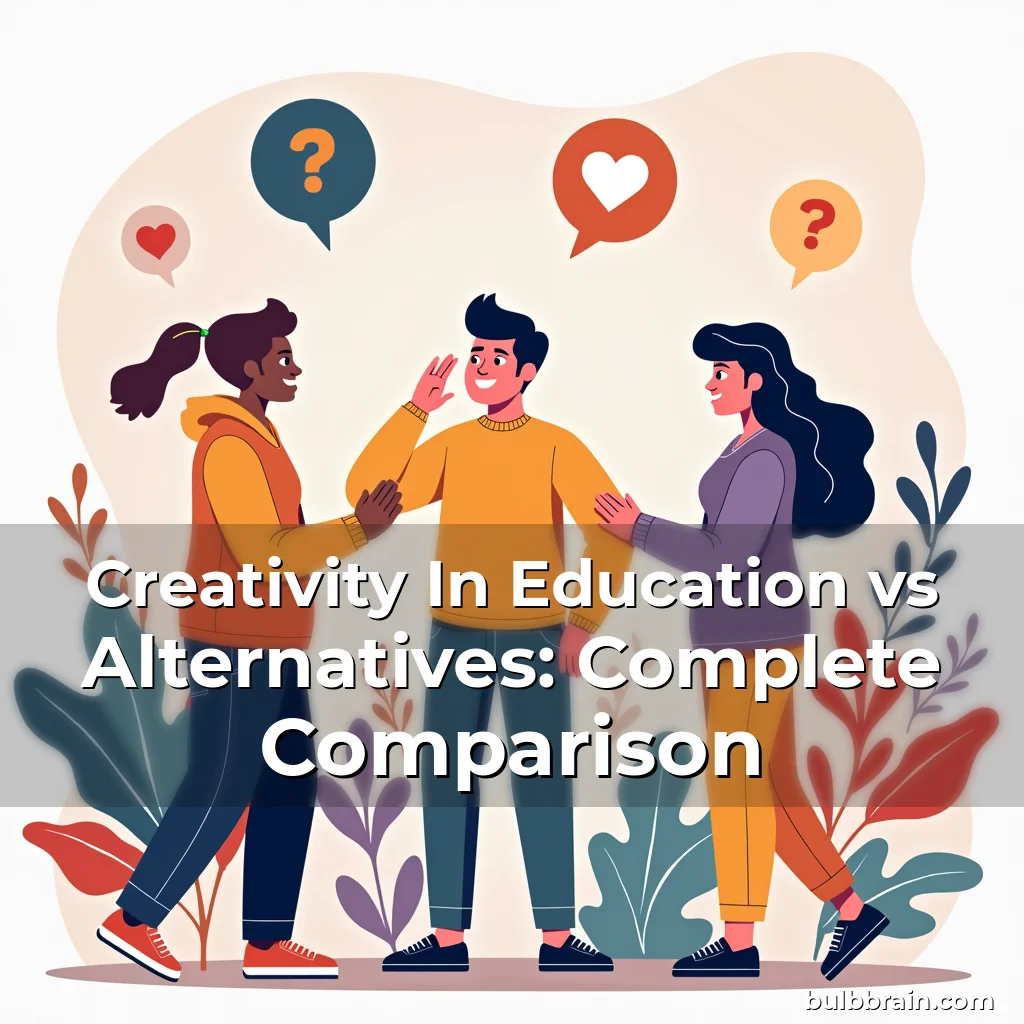
Creativity In Education vs Alternatives: Complete Comparison
In an era dominated by standardized testing and rigid curricula, creativity in education has emerged as both a challenge and a necessity. While traditional methods prioritize rote memorization and conformity, innovative approaches emphasize divergent thinking, problem-solving, and self-expression.
The debate over teaching styles continues to evolve, driven by research showing that creative learning fosters deeper engagement and long-term retention. Understanding how these methods compare to conventional alternatives is crucial for educators seeking meaningful change.
The Role Of Creativity In Modern Classrooms
Creativity in education transforms passive learners into active participants who question, experiment, and innovate. This shift aligns with modern pedagogical theories emphasizing student-centered learning environments.
Educators are increasingly integrating arts-based activities, design thinking frameworks, and open-ended projects into lesson plans. These strategies encourage students to explore multiple solutions rather than focusing solely on predetermined answers.
A growing body of evidence supports the cognitive benefits of creative instruction:
- Mindfulness exercises enhance attention spans and reduce anxiety during complex tasks
- Collaborative storytelling improves communication skills across diverse groups
- Scaffolded art projects boost spatial reasoning abilities in STEM fields
Classroom transformations often begin with small adjustments, such as allowing flexible seating arrangements or incorporating digital tools for multimedia presentations. These changes create psychological safety for risk-taking without fear of judgment.
Traditional Teaching Methods Revisited
Conventional educational models rely heavily on direct instruction, textbook-driven lessons, and standardized assessments. While these approaches have historical validity, their limitations become apparent when applied to modern learner needs.
The teacher-led lecture format dominates many classrooms, reinforcing hierarchical relationships between educators and students. This dynamic may discourage spontaneous questioning and limit opportunities for critical thinking.
Despite these shortcomings, traditional methods offer distinct advantages:
- Predictable outcomes through uniform grading systems
- Clear benchmarks for measuring academic progress
- Established protocols for classroom management
Critics argue that excessive reliance on textbooks narrows the scope of knowledge acquired. However, proponents maintain that structured curricula provide essential foundational understanding before advancing to more complex topics.
Fostering Creative Thinking Through Project-Based Learning
Project-based learning (PBL) redefines educational experiences by immersing students in real-world challenges that require sustained inquiry and collaboration. Unlike conventional assignments, PBL encourages authentic application of knowledge across disciplines.
This approach typically involves multi-week investigations where students identify problems, gather data, develop hypotheses, and present findings through various formats. Teachers act as facilitators rather than primary sources of information.
Research indicates that PBL enhances metacognitive awareness by prompting learners to reflect on their thought processes continuously. Students acquire not only subject-specific knowledge but also transferable skills like time management and peer feedback interpretation.
Evaluation becomes multifaceted, encompassing process documentation alongside final products. Rubrics assess creativity, effort, and adaptability in addition to factual accuracy.
Digital Tools Enhancing Educational Creativity
Technology integration presents unprecedented opportunities for cultivating creativity within educational settings. Digital platforms enable personalized learning journeys tailored to individual strengths and interests.
Interactive apps allow students to manipulate virtual objects, simulate scientific phenomena, and visualize abstract mathematical concepts dynamically. These tools make abstract ideas tangible while promoting exploratory learning.
Online collaboration spaces facilitate cross-cultural exchanges and global teamwork possibilities previously unimaginable in physical classrooms. Virtual reality environments immerse users in simulated scenarios requiring creative responses.
However, digital immersion must be balanced with face-to-face interactions. Over-reliance on screens could potentially hinder interpersonal development aspects vital for emotional intelligence growth.
The Impact Of Teacher Training On Creative Instruction
Effective implementation of creative teaching requires substantial investment in professional development programs for educators. Traditional teacher training often lacks emphasis on fostering innovation within curriculum delivery.
Workshops focused on experiential learning techniques help instructors build confidence in using unconventional methodologies. Ongoing mentorship programs ensure sustainable adoption beyond initial experimentation phases.
Data from OECD studies reveals interesting correlations:
- Schools with regular PD sessions show 38% higher rates of successful innovation initiatives
- Teachers receiving creative coaching report increased job satisfaction levels
- Students taught by trained creative educators demonstrate improved problem-solving agility
Continuous support mechanisms prove crucial for overcoming resistance stemming from institutional inertia or parental skepticism towards non-traditional approaches.
Measuring Success Beyond Standardized Metrics
Evaluating creativity poses unique challenges compared to assessing conventional academic achievement through numerical scores. Alternative assessment frameworks better capture qualitative indicators of inventive capacity.
Rubric designs incorporate criteria such as originality, adaptability, and interdisciplinary connections when judging creative outputs. Peer assessment components add value by exposing students to different perspectives.
Portfolios serve as dynamic records showcasing progressive skill development over extended periods. They include drafts, reflections, and revisions illustrating iterative improvement processes.
Balanced evaluation systems recognize that creative competence develops gradually through consistent practice rather than achieving perfection overnight.
Navigating Institutional Barriers To Innovation
Many schools face bureaucratic hurdles preventing meaningful reform despite clear benefits associated with creative education practices. Administrative structures often prioritize compliance over exploration.
Funding constraints frequently dictate program availability, limiting access to cutting-edge resources required for immersive learning experiences. Personnel policies sometimes discourage experimentation due to performance metrics tied exclusively to test scores.
Successful navigation demands strategic advocacy efforts including:
- Building coalitions among stakeholders sharing common goals
- Demonstrating measurable improvements through pilot programs
- Leveraging research findings to inform policy decisions
Gradual systemic changes usually yield greater longevity compared to abrupt top-down mandates that fail to account for local contextual factors.
Global Perspectives On Creative Pedagogy
Creative teaching methods manifest differently across cultures based on societal values, economic conditions, and historical contexts. Comparative analysis offers insightful perspectives regarding effective implementations worldwide.
Nordic countries emphasize holistic development through play-based learning at early ages. Their systems integrate artistic expression naturally into core subjects unlike some other regions.
In contrast, East Asian educational traditions often balance rigorous academics with mindfulness practices that nurture creativity indirectly. This synthesis reflects cultural priorities valuing discipline alongside imagination.
Globally, there’s increasing recognition of the need for localized adaptations ensuring relevance while maintaining universal principles supporting creative learning environments.
Future Directions For Creative Education
Ongoing technological advancements promise new dimensions for imaginative instruction. Artificial intelligence applications may personalize learning paths according to each student’s creative preferences and aptitudes.
Immersive technologies like augmented reality could revolutionize field trips by enabling virtual explorations of historical sites or distant ecosystems without geographical restrictions.
Evolving workforce requirements underscore the importance of continuous adaptation in educational paradigms. Future-ready graduates must possess flexible thinking capabilities applicable across rapidly changing industries.
Interdisciplinary collaborations between schools and industry partners will likely expand, offering students real-world problem-solving opportunities that mirror contemporary challenges faced globally.
Conclusion
Creativity in education represents more than a passing trend; it signifies fundamental shifts toward more inclusive, adaptable learning ecosystems capable of preparing students for uncertain futures.
To cultivate truly transformative educational experiences, policymakers, administrators, and teachers must collectively commit to reimagining what’s possible within classroom walls today and tomorrow.

news is a contributor at BulbBrain. We are committed to providing well-researched, accurate, and valuable content to our readers.
You May Also Like
About news
Passionate about learning, cognitive science, and helping people unlock their full potential.