
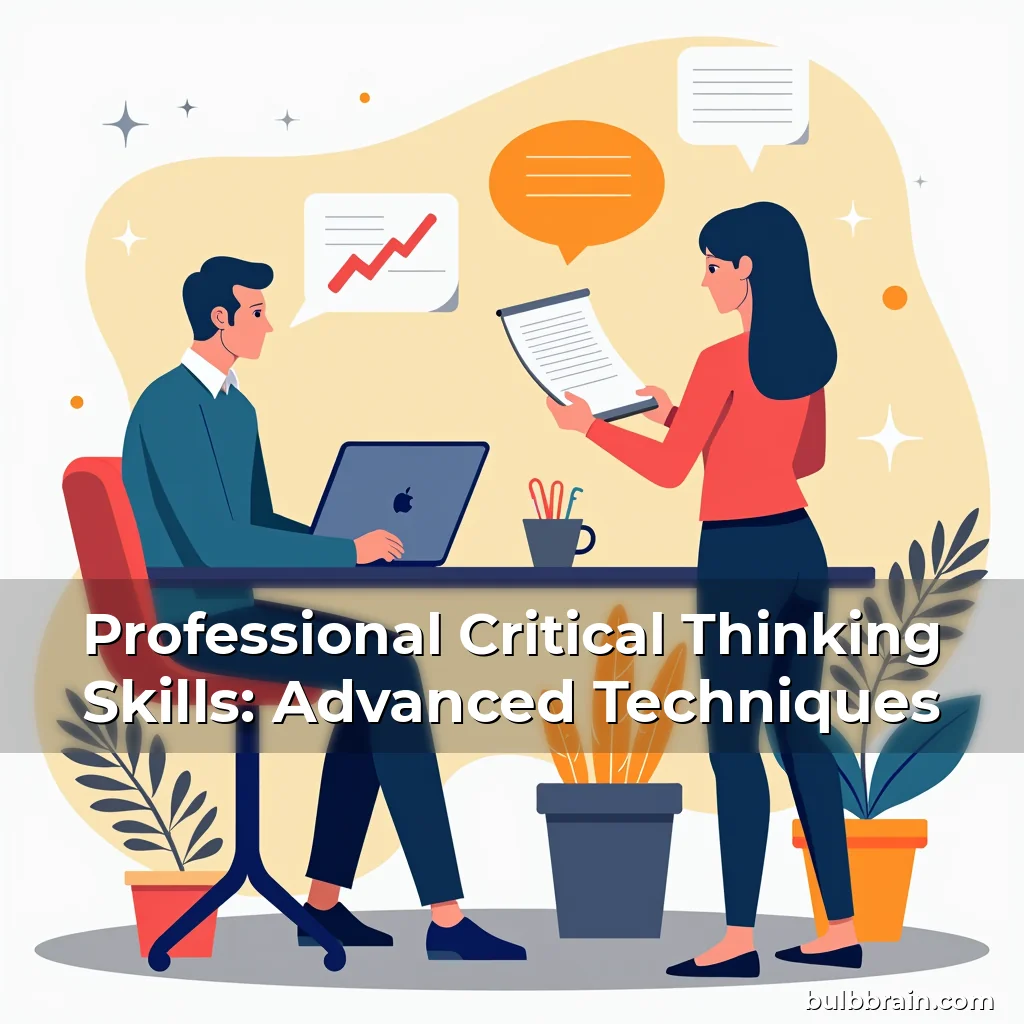
Unlocking Strategic Thought: Mastering Advanced Critical Thinking Techniques for Real-World Impact
Critical thinking is not merely an intellectual exercise; it is the cornerstone of strategic decision-making that transforms raw information into actionable insight. In today’s fast-paced digital age, where misinformation spreads rapidly across platforms, cultivating advanced critical thinking skills has become essential for professionals seeking to navigate complex challenges effectively.
The ability to dissect arguments, analyze data patterns, and recognize logical fallacies distinguishes top performers from average ones. This guide explores cutting-edge techniques designed specifically for professionals aiming to refine their analytical capabilities beyond conventional wisdom, enabling them to make smarter choices at work and in life.
The Cognitive Framework of Advanced Analytical Reasoning
At its core, critical thinking involves systematic analysis through well-defined cognitive processes. While basic problem-solving focuses on finding solutions, advanced critical thinking requires evaluating multiple perspectives before arriving at conclusions.
Professionals must develop mental models that allow them to assess situations objectively while remaining open to alternative viewpoints. This dual approach prevents confirmation bias but also ensures thorough consideration of all relevant factors influencing any given scenario.
Mental frameworks such as the Socratic method encourage deep questioning by challenging assumptions rather than accepting surface-level answers. By repeatedly asking “why” and “how,” individuals can peel back layers of complexity within seemingly simple problems.
Experts often employ concept mapping tools to visualize relationships between different elements involved in a situation. These visual aids help identify hidden connections and potential blind spots that might otherwise remain undetected during traditional analysis methods.
- Active listening: Pay close attention to underlying messages instead of focusing solely on spoken words when analyzing verbal communication.
- Evidence-based evaluation: Always cross-check claims against credible sources before accepting them as factual truth.
- Situational awareness: Maintain constant vigilance regarding contextual cues that could influence interpretation accuracy.
Integrating these practices into daily routines helps build durable analytical habits over time rather than relying on sporadic bursts of concentration during high-stakes moments.
Advanced thinkers understand that clarity often emerges after multiple cycles of inquiry and reflection. They don’t expect instant epiphanies but instead embrace iterative exploration as part of the natural progression toward deeper understanding.
Dismantling Logical Fallacies Through Pattern Recognition
Identifying common logical fallacies equips professionals with powerful tools for discernment. Many business decisions fail due to misinterpretation of cause-effect relationships or faulty generalizations drawn from limited samples.
Awareness of fallacy types enables practitioners to spot weaknesses in both internal thought processes and external communications they receive from colleagues, clients, or media outlets. Common pitfalls include hasty generalizations based on insufficient evidence and appeals to emotion masking weak rationales.
Systematic training in recognizing these errors significantly improves decision quality. Studies show that employees who regularly engage in fallacy detection exercises demonstrate improved performance metrics compared to those without similar exposure.
Case Study: The Role of Confirmation Bias in Market Analysis
In financial markets, confirmation bias frequently leads investors astray by reinforcing preexisting beliefs despite contradictory data points. A notable example occurred during the dot-com bubble when analysts overlooked red flags because they were primed to believe internet stocks would dominate indefinitely.
This phenomenon highlights how even seasoned experts are vulnerable to cognitive biases unless actively monitored. Implementing structured review protocols that force re-evaluation of initial hypotheses can mitigate such risks dramatically.
Research published in the Journal of Financial Economics reveals that teams incorporating diverse perspectives reduce error rates by up to 40% when assessing market trends. This underscores the importance of assembling multidisciplinary groups capable of identifying blind spots others may miss.
By establishing routine audits of assumptions and implementing peer review systems, organizations create environments conducive to continuous learning and self-correction mechanisms crucial for long-term success.
Cultivating Intellectual Humility Through Structured Inquiry
Intellectual humility forms the foundation upon which true expertise develops. It involves acknowledging gaps in knowledge while maintaining curiosity about what remains unknown.
Successful professionals exhibit openness towards revising previously held convictions when confronted with compelling new evidence. This trait becomes particularly vital when dealing with rapidly evolving fields requiring constant adaptation.
Purposeful skepticism encourages investigation rather than dismissal. Instead of automatically rejecting novel ideas, effective thinkers probe underlying premises systematically before forming judgments.
Humility manifests in willingness to seek out dissenting opinions deliberately rather than waiting for opposition to arise organically. Proactively engaging with counterarguments strengthens overall argument resilience.
- Self-assessment rituals: Regularly evaluate personal growth areas using objective criteria established independently of external validation.
- Cross-disciplinary engagement: Explore domains outside immediate professional scope to broaden conceptual toolkits available for problem solving.
- Peer accountability circles: Participate in group discussions focused explicitly on exposing each other’s unconscious biases and assumptions.
Fostering this mindset creates fertile ground for innovation since it removes barriers preventing exploration of unconventional approaches that might yield breakthrough results.
Organizational cultures promoting psychological safety enable employees to express doubts openly without fear of reprisal. Such environments correlate strongly with increased creativity and risk-taking behaviors beneficial for competitive advantage.
Data Synthesis Strategies for Complex Decision-Making
Modern professionals face unprecedented volumes of data demanding sophisticated synthesis techniques. Effective information processing demands distinguishing signal from noise amidst vast datasets.
Strategic filtering methods prioritize relevance over quantity by applying predefined criteria that align precisely with organizational objectives. This targeted approach prevents cognitive overload caused by trying to absorb every piece of available information simultaneously.
VISUALIZATION TOOLS transform abstract numerical representations into comprehensible formats facilitating quicker pattern recognition. Interactive dashboards provide dynamic views revealing correlations invisible within static reports.
Beyond mere presentation enhancements, visualization serves as analytical accelerators by allowing users to manipulate variables and observe resulting changes instantly—an invaluable capability for predictive modeling scenarios.
Implementing Data-Driven Workflows Across Departments
Successful integration of data analytics requires cross-functional collaboration ensuring alignment between technical implementation and operational needs. IT departments must coordinate closely with end-users throughout development cycles.
Training programs tailored specifically for non-technical staff ensure everyone understands how to interpret key metrics meaningfully. This democratization of data literacy fosters shared responsibility for informed decision-making at all levels.
Regular calibration sessions maintain consistency standards across different teams working with related datasets. Establishing unified KPI definitions prevents confusion arising from conflicting measurements used interchangeably without clear distinctions.
Cross-departmental workshops cultivate collective ownership of data governance principles strengthening institutional commitment to accuracy and transparency throughout operations.
Building Resilient Problem-Solving Mindsets
Resilience in problem-solving stems from adopting flexible approaches adaptable to changing circumstances. Fixed methodologies risk becoming obsolete when environmental conditions evolve unexpectedly.
Adaptive thinking emphasizes experimentation as opposed to rigid adherence to predetermined plans. Successful innovators view setbacks as diagnostic feedback rather than failures warranting discouragement.
Scenario planning prepares individuals for uncertainty by considering multiple possible futures simultaneously. This proactive stance enhances responsiveness when unexpected events disrupt existing trajectories.
Risk tolerance profiles vary depending on industry contexts but generally involve balancing caution with calculated boldness. Understanding appropriate thresholds allows professionals to pursue opportunities judiciously without undue hesitation.
- Ideation sprints: Time-bound creative sessions focused exclusively on generating options rather than immediate implementation.
- Prototyping phases: Develop simplified versions of proposed solutions to test feasibility efficiently before full-scale deployment.
- Post-mortems reviews: Systematically examine outcomes following project completion to extract lessons applicable elsewhere.
Cultivating these traits establishes robust foundations supporting sustained progress even under pressure. Organizations benefit greatly from fostering cultures encouraging continual refinement of processes through persistent iteration cycles.
Leadership plays pivotal roles here by modeling desired behaviors themselves—demonstrating comfort with ambiguity and showing appreciation for thoughtful challenge of prevailing norms.
Enhancing Communication Clarity in Argument Construction
Clear articulation of positions relies heavily on precise language selection reflecting intended meanings accurately. Ambiguous phrasing introduces unnecessary uncertainties complicating comprehension efforts.
Structuring arguments logically follows principles akin to academic writing—introducing thesis statements followed by supportive evidence arranged coherently according to relevance priorities.
Visual metaphors enhance persuasiveness by anchoring abstract concepts within familiar reference frames making complex ideas easier to grasp intuitively.
Consistency in terminology usage maintains coherence throughout extended dialogues preserving continuity necessary for sustained engagement without confusing audiences unnecessarily.
Tech Tools for Streamlining Persuasive Communication
Software applications aid in organizing thoughts systematically prior to delivery enhancing message precision considerably. Mind-mapping software offers intuitive interfaces for structuring complicated narratives visually.
Speech-to-text transcriptions facilitate review possibilities enabling speakers to refine formulations based on written feedback received post-delivery. This reflective process supports gradual improvement over successive iterations.
Interactive storytelling platforms allow creators to embed multimedia elements enriching presentations with contextually relevant visuals augmenting textual descriptions effectively.
Collaborative editing features embedded within document management systems promote real-time idea exchange improving final product quality through combined contributions rather than solitary composition alone.
Navigating Ethical Dilemmas with Philosophical Rigor
Ethics committees routinely struggle with defining universally acceptable conduct lines amid divergent cultural expectations shaping moral perceptions globally. Navigating gray areas necessitates rigorous philosophical examination grounded firmly in empirical realities.
Applying ethical theories provides structured frameworks guiding difficult choices faced daily across professions ranging from healthcare providers grappling with patient autonomy issues to engineers weighing public safety concerns against corporate interests.
Kantian ethics emphasize duty fulfillment regardless of situational outcomes whereas utilitarian perspectives favor actions producing greatest good for majority affected parties irrespective of individual preferences.
Deontological vs teleological debates persist unresolved highlighting limitations inherent in any single theoretical model attempting absolute rule creation for inherently variable human experiences.
- Consequentialist evaluations: Focus primarily on measurable impacts stemming from chosen courses of action.
- Rule-based morality: Prioritize adherence to established guidelines even when exceptions seem reasonable under particular conditions.
- Contextual relativism: Acknowledge cultural differences affecting perception of right/wrong dichotomies across geographies.
Broadening perspective through comparative studies increases sensitivity toward differing worldviews enhancing intercultural competence increasingly required in globalized workplaces.
Establishing transparent decision-making processes involving stakeholders ensures buy-in reducing resistance encountered when implementing controversial policies perceived as imposed externally without sufficient consultation beforehand.
Lifelong Learning Mechanisms for Continuous Improvement
Ongoing education sustains professional relevance by keeping knowledge current alongside technological advancements reshaping industries continuously. Passive consumption fails however without deliberate application strategies integrating newly acquired competencies practically.
Microlearning modules offer efficient ways absorbing incremental updates without overwhelming schedules burdened by competing responsibilities. Bite-sized lessons fit easily around busy calendars maximizing retention effectiveness.
Knowledge communities serve as collaborative networks exchanging insights freely creating ecosystems where mutual support thrives naturally through shared aspirations toward excellence pursuit.
Feedback loops reinforce learning gains by providing measurable benchmarks indicating progress achieved relative to baseline performances establishing clear indicators demonstrating value derived from investments made.
Personal Development Plans as Strategic Roadmaps
Individuals benefit immensely from crafting personalized advancement charts outlining specific milestones aligned with career goals. These roadmaps function similarly to business strategy documents translating vague ambitions into concrete action items.
Performance metrics track achievements against defined targets allowing periodic reassessments determining whether trajectory adjustments prove necessary based on emerging realities impacting original assumptions.
Coaching relationships provide external perspectives helping identify blind spots hindering growth potential otherwise unnoticed internally. Mentors act as sounding boards testing ideas rigorously before committing resources toward implementations.
Continuous assessment practices ensure readiness for evolving requirements maintaining competitiveness consistently within dynamic market landscapes constantly shifting beneath ever-changing consumer expectations.
Conclusion
Cultivating advanced critical thinking skills represents an ongoing journey requiring dedication toward mastering nuanced analytical abilities applicable across varied professional settings. These techniques empower individuals to thrive amidst increasing informational complexities characterizing modern society.
To begin your transformation, commit to daily practice routines embedding key principles discussed throughout this guide into habitual behaviors. Remember that mastery derives not from occasional effort but from consistent application guided by conscious intent toward continual enhancement.

news is a contributor at BulbBrain. We are committed to providing well-researched, accurate, and valuable content to our readers.
You May Also Like

About news
Passionate about learning, cognitive science, and helping people unlock their full potential.