
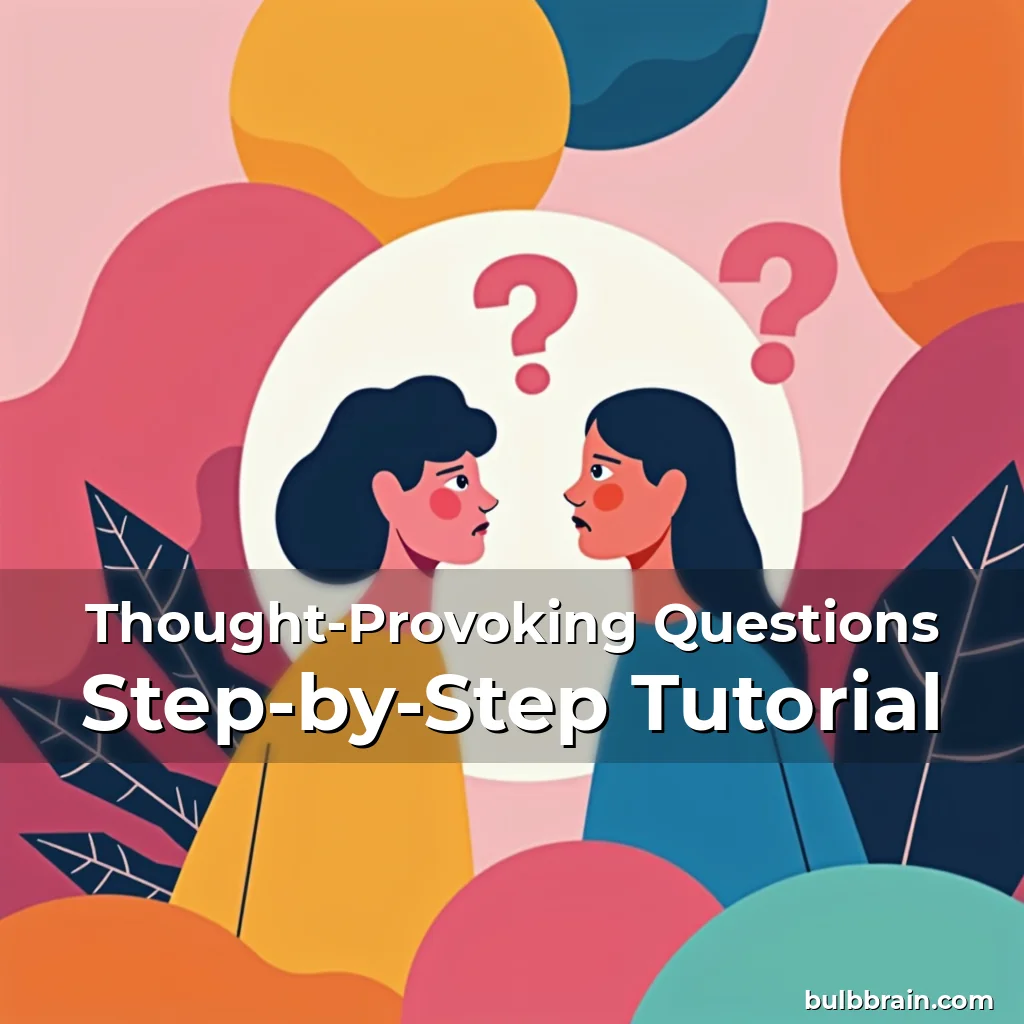
The Art of Inquiry: Cultivating Curiosity Through Thought-Provoking Questions
In an age where information is abundant yet often shallow, the power of deep questioning has never been more crucial. Thought-provoking questions serve as intellectual catalysts that challenge assumptions, spark creativity, and drive meaningful conversations. Whether you’re seeking personal growth, enhancing team dynamics, or simply exploring new ideas, learning how to ask compelling questions can transform your interactions and expand your horizons.
This guide explores the art of inquiry through a structured approach. It delves into why certain types of questions are particularly effective at stimulating critical thinking while also providing practical strategies for crafting impactful queries across various contexts—personal development, education, business innovation, philosophical exploration, creative problem-solving, relationship building, and self-reflection. By understanding both theory and application behind powerful questioning techniques, readers will gain tools they can apply immediately in their daily lives.
Fostering Intellectual Growth Through Strategic Questioning
At its core, asking thought-provoking questions is not merely about gathering facts; it’s about igniting curiosity and encouraging deeper exploration of complex topics. When we engage others—or ourselves—with well-crafted inquiries, we create space for reflection, analysis, and synthesis of knowledge. This process fosters cognitive flexibility by pushing individuals beyond surface-level responses toward more nuanced understandings.
Strategic questioning involves using open-ended prompts rather than simple yes/no answers. These kinds of questions invite elaboration and allow respondents to express their perspectives fully. For example, instead of asking “Do you believe climate change is real?” which invites only binary responses, one might rephrase it as “What do you think are the most significant environmental challenges facing our planet today, and what solutions could address them?” Such phrasing encourages broader consideration of issues.
- Open-ended questions: Encourage detailed responses that reveal underlying beliefs or motivations.
- Reflective questions: Prompt introspection by inviting people to examine their own thoughts and actions.
- Hypothetical scenarios: Stimulate imagination by considering alternative realities or outcomes.
- Probing follow-ups: Build upon initial answers to uncover deeper layers of meaning.
Each type serves different purposes depending on context but collectively contributes to a richer exchange of ideas. Open-ended questions lay groundwork for discussion, reflective ones facilitate internal dialogue, hypotheticals stretch creative boundaries, and probing follows up effectively after any response. Mastering these four categories enables anyone—from students to professionals—to enhance communication quality significantly.
Cognitive engagement increases when individuals feel challenged intellectually but supported emotionally during discussions. Therefore, balancing challenging questions with empathy ensures participants remain motivated without feeling overwhelmed. Techniques such as active listening, paraphrasing key points back to speakers, and acknowledging emotions help maintain productive exchanges even amidst difficult subjects.
Enhancing Learning Experiences With Effective Questioning Strategies
Educators play pivotal roles in shaping young minds through thoughtful question design. Research indicates that classrooms employing high-quality questioning methods see improved student performance across multiple domains including critical thinking skills, retention rates, and overall academic achievement. One study published in Educational Psychology Review found that teachers who regularly used higher-order thinking questions saw marked improvements in students’ ability to analyze texts critically compared to those relying solely on recall-based assessments.
Effective teaching requires moving past rote memorization towards fostering analytical abilities via targeted interrogations. Bloom’s Taxonomy provides useful framework here since it categorizes cognitive processes from basic remembering upwards through evaluating and creating. Teachers aiming to promote deeper learning would benefit greatly from incorporating questions aligned with upper levels of this taxonomy—such as “How does this concept relate to other areas within [subject]?” or “Can you predict potential consequences if [theory] were applied differently?”
Bloom’s Taxonomy Applied To Classroom Discussions
Bloom’s Taxonomy offers educators systematic way to structure lessons around progressively complex tasks aimed at developing comprehensive understanding among learners. At lowest level (“remember”), students identify definitions or formulas. Moving upward through comprehend, apply, analyze, evaluate, and finally create stages allows instructors gradually build complexity until reaching highest form of cognition—original creation based on synthesized information.
To illustrate application practically consider math class scenario: beginning with recalling multiplication tables (remember), then applying algorithms to solve equations (apply), analyzing patterns emerging from repeated operations (analyze), evaluating effectiveness of various solution paths (evaluate), culminating in designing novel problems requiring multi-step approaches (create). Each stage represented distinct set of questions tailored specifically for developmental purpose.
Implementing this model consistently helps ensure students don’t become passive recipients of knowledge but active participants constructing meaning themselves. Furthermore, it equips future generations with essential life skills like logical reasoning, ethical judgment, and innovative thinking—all vital components modern workforce demands increasingly.
Teachers must recognize value of silence following posed query too. Allowing sufficient time before expecting answer gives students opportunity to formulate coherent responses rather than rushing through superficial replies. Modeling patience demonstrates respect for intellectual effort required during processing phase—an attitude likely influencing classroom culture positively over time.
Driving Innovation In Business Settings Via Insightful Queries
In corporate environments, strategic questioning drives breakthrough innovations. Companies leveraging robust interrogation frameworks report increased product development cycles efficiency along with enhanced employee morale due to greater sense ownership regarding initiatives undertaken collaboratively. A Harvard Business Review case study highlighted firm implementing weekly brainstorm sessions centered exclusively around provocative questions resulting in tripled patent applications within year period.
Leadership teams benefit immensely from cultivating cultures where posing bold questions becomes normative behavior. Rather than focusing purely on executing plans efficiently, organizations embracing exploratory mindset prioritize generating disruptive ideas first. Questions framed around unmet customer needs (“What problems exist currently unsolved by existing products?”), market gaps (“Which segments remain underserved despite industry growth trends?”), technological limitations (“Where do current technologies fall short relative to user expectations?”) provide fertile ground for groundbreaking ventures.
Case Study: How Google Uses Questions To Fuel Product Development
Google exemplifies successful integration of inquiry-driven methodologies throughout operational hierarchy. Their famous “20% Time” policy allowing employees dedicate portion workweek pursuing passion projects stemmed originally from foundational belief that genuine interest sparks best innovations. Regularly scheduled retrospectives encourage staff members reflect deeply on experiences through guided questioning sessions focused themes like impact measurement, scalability concerns, or ethical implications associated proposed changes.
One notable outcome resulted from iterative questioning around search algorithm enhancements. Initial queries explored basic functionality—”Is there faster method retrieving relevant results?”—but evolved rapidly into examining broader societal effects—”How might altered ranking systems affect small businesses visibility online?”—ultimately leading development of features prioritizing local enterprise discoverability thereby increasing platform utility dramatically.
Such examples underscore importance embedding curiosity-centric practices within institutional DNA. Organizations willing invest resources training personnel master artistry surrounding potent querying reap substantial rewards manifesting tangible competitive advantages across industries ranging from tech startups to multinational conglomerates alike.
Navigating Philosophical Explorations Through Deep Reflection
Philosophy thrives precisely because it dares confront fundamental questions about existence itself. Engaging with profound dilemmas related morality, consciousness, free will, etc., necessitates mastery over articulating precise yet expansive formulations capable evoking rich discourse. Crafting astute philosophical queries demands balance between specificity enough guiding conversation direction versus openness permitting diverse interpretations flourish naturally.
Historically renowned thinkers employed distinctive styles when formulating seminal inquiries defining entire disciplines. Socrates famously utilized dialectic method emphasizing relentless cross-examination aimed exposing contradictions inherent flawed arguments—his technique known Socratic Method remains cornerstone pedagogical tool worldwide still. Contrastingly Descartes approached metaphysical puzzles through systematic doubt starting premise “I think therefore I am,” establishing epistemological foundation subsequent centuries relied heavily upon.
Ten Iconic Philosophical Questions That Shape Human Understanding
Throughout history few questions have resonated universally across cultures epochs. Ten standouts include:
- “What is truth?”: Explored extensively Plato dialogues, continues debated contemporary ethics debates.
- “Does God exist?”: Central theme Abrahamic faiths, subject intense scrutiny scientific communities too.
- “Why do we suffer?”: Investigated Buddhism Hinduism Christianity offering varied perspectives suffering role spiritual journeys.
- “Are we free agents or determined beings?”: Debate spans neuroscience psychology philosophy impacting legal systems globally.
- “What constitutes happiness?”: From Epicurus Stoics modern positive psychology researchers continue probe nature fulfillment.
- “Can machines possess consciousness?”: Emerging field artificial intelligence raises existential stakes concerning human uniqueness.
- “What defines justice?”: Ancient Greeks pondered deeply issue now central social contract theories political science.
- “What happens after death?”: Universal preoccupation informing religious doctrines scientific investigations alike.
- “Is there such thing as objective reality?”: Quantum physics challenges classical notions certainty perception.
- “Should humans colonize outer space?”: Ethical considerations extend beyond mere technical feasibility involve interstellar responsibility.
These timeless musings continue fueling scholarly pursuits public contemplation equally. They remind us that questioning isn’t endpoint journey—itself ongoing expedition toward fuller comprehension universe we inhabit together.
Engagement with such profound matters requires careful framing so audiences grasp depth intent behind each formulation. Avoid jargon whenever possible favor accessible language maintains inclusivity ensuring wider participation regardless background expertise levels present.
Creative Problem Solving Through Innovative Question Framing
Creativity flourishes under conditions where constraints transformed into opportunities through imaginative reframing. Design thinking methodology popularized IDEO Stanford d.school hinges largely upon posing unconventional questions designed provoke radical departures conventional wisdom. Instead traditional “how can we fix X?” becomes “If we had unlimited resources, how would we reimagine X entirely?” shifting focus from remediation transformational possibilities.
Entrepreneurs artists scientists alike employ similar tactics routinely. Consider Steve Jobs’ legendary quote “Stay hungry stay foolish”—it encapsulates ethos valuing perpetual quest discovery over complacency status quo. Similarly Da Vinci maintained notebooks filled observations inspired seemingly mundane phenomena prompting further investigation leading monumental discoveries later.
Seven Revolutionary Questions Inspiring Groundbreaking Innovations
History showcases numerous instances where revolutionary questions sparked paradigm shifts reshaping societies forever. Notable examples include:
- “What if gravity wasn’t constant?”: Einstein’s General Theory Relativity emerged precisely from contemplating non-uniform gravitational forces altering spatial fabric itself.
- “Could electricity replace coal as primary energy source?”: Edison Tesla debates electrification revolutionized global infrastructure paving path modern civilization.
- “Might microorganisms hold keys curing diseases?”: Pasteur’s germ theory fundamentally changed medical practices saving countless lives annually.
- “How could we communicate instantaneously across distances?”: Bell’s telephone invention answered this query ushering era telecommunications explosion.
- “Is there intelligent life elsewhere cosmos?”: SETI project dedicated decades searching signals extraterrestrial civilizations expanding cosmic perspective humanity.
- “Can digital data represent physical objects accurately?”: CAD software development enabled unprecedented precision engineering fields transforming manufacturing capabilities.
- “What if materials behaved oppositely expected?”: Graphene research revealed extraordinary properties defying prior material science predictions opening new frontiers nanotechnology.
Each breakthrough originated simple yet audacious inquiry challenging prevailing dogmas. Modern innovators seeking disruption should emulate same spirit daring explore territories deemed impractical initially. Remember every great idea once considered fringe notion before becoming mainstream reality.
Crafting such transformative queries demands courage conviction willingness embrace uncertainty. It also benefits greatly from interdisciplinary collaboration bringing fresh viewpoints previously unseen angles. Cross-pollination ideas between disparate fields frequently yields unexpected synergies accelerating progress exponentially.
Strengthening Relationships Through Meaningful Conversations
Human connections thrive when nurtured through authentic exchanges rooted mutual understanding. Thoughtfully constructed questions act bridges facilitating deeper emotional intimacy between individuals whether romantic partners colleagues friends family members. Unlike transactional dialogue focused goals completion, relational conversations prioritize presence connection fostering trust vulnerability necessary healthy bonds.
Relationship experts emphasize importance nonjudgmental atmosphere created through respectful listening attentive responses. When approaching sensitive topics, phrasing matters considerably. Rather than accusatory tone implying blame, empathetic framing promotes healing reconciliation. Example: Changing “You always ignore me” into “It feels lonely sometimes when we don’t talk much—I wonder how we could connect better?” transforms confrontation invitation collaborative problem solving.
Twelve Relationship-Building Questions To Ask Loved Ones
Curious exploration shared experiences lays groundwork enduring relationships built upon solid foundations. Here twelve insightful prompts ideal initiating meaningful chats:
- “What makes you feel truly alive?”: Reveals passions values driving person’s motivation.
- “What’s something you’ve recently discovered about yourself?”: Shows commitment personal growth awareness evolving identity.
- “Who was someone who profoundly impacted your life, and why?”: Helps trace influences shaping character worldview.
- “If money weren’t object, what would you pursue wholeheartedly?”: Uncovers hidden dreams aspirations worth honoring.
- “What’s a lesson learned hardship that changed perspective permanently?”: Demonstrates resilience capacity grow through adversity.
- “Describe moment felt completely understood accepted.” : Highlights need validation affirmation intrinsic worth.
- “What does success mean personally?”: Clarifies individual definition achievements fulfilling life.
- “What fears prevent taking risks you know you should?”: Identifies barriers limiting full potential expression.
- “When did you last feel genuinely proud of yourself?”: Reinforces self-esteem acknowledges accomplishments deserved recognition.
- “What brings smile without reason?”: Discovers sources joy simplicity everyday moments.
- “What advice would give younger version yourself?”: Offers wisdom gleaned life experience benefiting others similarly situated.
- “What’s one thing nobody knows about you that surprised them?”: Adds dimensionality depth personality making interactions memorable.
Regular use these prompts cultivate environment where openness encouraged appreciated. As relationships deepen, natural evolution occurs—from casual acquaintanceships lasting friendships partnerships grounded mutual respect admiration. Consistent practice leads stronger interpersonal networks resilient against external pressures common modern society faces constantly.
Remember effective communication relies reciprocity. While asking poignant questions initiates flow, responding thoughtfully sustains momentum. Active listening demonstrates genuine interest enhances rapport reciprocally strengthening ties over time. This balanced interaction creates safe haven for honest expression nurturing bond continuously growing maturing together.
Self-Reflection And Personal Development Through Introspective Inquiry
Internal dialogue forms bedrock self-awareness crucial navigating complexities inner world. Deliberate introspection achieved through meticulously crafted questions guides individuals toward clarity purpose enabling conscious choices aligning with truest selves. Journaling meditation mindfulness exercises complement this process, yet none substitutes rigorous examination prompted by incisive self-interrogation.
Psychologists advocate structured routines promoting regular self-assessment to track progression monitor alignment between actions ideals. Setting aside dedicated time each day week engages in reflective practices sharpens insight accelerates growth trajectory. Questions formulated around core values, long-term objectives, emotional triggers, recurring patterns, and behavioral tendencies offer rich terrain for exploration.
Twenty Self-Discovery Prompts For Daily Mindfulness Practices
To initiate journey inward, consider integrating following twenty reflective prompts into routine:
- “Am I living according to my core values today?”: Ensures congruence between behaviors principles.
- “What habits contribute positively negatively toward achieving goals?”: Identifies reinforcing detrimental patterns needing modification.
- “What emotion surfaced strongest yesterday, and why?”: Recognizes subconscious drivers influencing decisions.
- “Did anything happen recently that challenged perceptions about myself?”: Opens door reconsidering fixed notions about identity.
- “What aspect of my life feels out-of-balance right now?”: Pinpoints areas requiring attention restoration equilibrium.
- “What did I learn about myself lately that surprises me?”: Celebrates unexpected revelations advancing self-understanding.
- “What fear keeps resurfacing, and what does it say about me?”: Unearths root causes anxieties hindering forward movement.
- “Whose opinion holds greatest weight in my decision-making?”: Examines influence outside voices may distort internal compass.
- “What would I tell my future self if given chance?”: Projects vision ahead cultivates accountability.
- “What legacy do I want leave behind?”: Anchors purpose reminding significance contributions matter.
- “What’s one thing I’m grateful for today?”: Shifts focus appreciation gratitude counterbalancing negativity.
- “Have I been kinder to others than myself recently?”: Assesses compassion quotient extending toward self.
- “What’s holding me back from pursuing dream?”: Confronts obstacles preventing realization ambitions.
- “What does peace look sound feel like for me personally?”: Defines subjective tranquility aiding stress management.
- “What message does my body convey about current state?”: Attunes physiological cues indicating wellness vitality.
- “What stories do I repeat mentally that limit potential?”: Challenges limiting narratives constraining expansion.
- “What talents remain unused despite possessing them?”: Invites activation dormant capacities enriching existence.
- “What does authenticity feel like when practiced consistently?”: Validates integrity affirming truthfulness paramount value.
- “What’s something I avoided confronting recently, and why?”: Addresses avoidance mechanisms impeding resolution.
- “What would make me proud of myself tomorrow?”: Sets aspirational benchmarks motivating intentional efforts.
Consistently revisiting these reflections builds mental muscle memory recognizing patterns identifying leverage points optimizing life accordingly. Like fitness regimen, consistency proves key unlocking latent capabilities transforming vague intentions concrete achievements measurable outcomes.
Integrating daily introspective rituals doesn’t guarantee perfection—but guarantees progress. Embrace imperfections encountered along path knowing each step forward counts toward realizing fullest potential uniquely yours. Through persistent inquiry, individuals cultivate resilience adaptability indispensable traits thriving ever-changing landscape modern existence presents relentlessly.
Conclusion
Mastering the art of asking thought-provoking questions unlocks immense potential for personal and collective advancement. From educational settings to corporate boardrooms, philosophical arenas to intimate relationships, strategic inquiry serves as universal connector amplifying understanding wherever deployed effectively. By adopting deliberate approaches cultivating curiosity, everyone gains capacity inspire ignite transformations occurring simultaneously externally internally.
As demonstrated throughout this exploration, powerful questioning transcends mere conversational tactic—it becomes lifestyle choice embracing continual growth through engaged exploration. Let this guide serve reminder: every great thinker, leader, creator began somewhere curious enough dared inquire boldly. Now it’s turn to join ranks those fearless seekers ready reshape worlds—one meaningful question at time.

news is a contributor at BulbBrain. We are committed to providing well-researched, accurate, and valuable content to our readers.
You May Also Like
About news
Passionate about learning, cognitive science, and helping people unlock their full potential.