
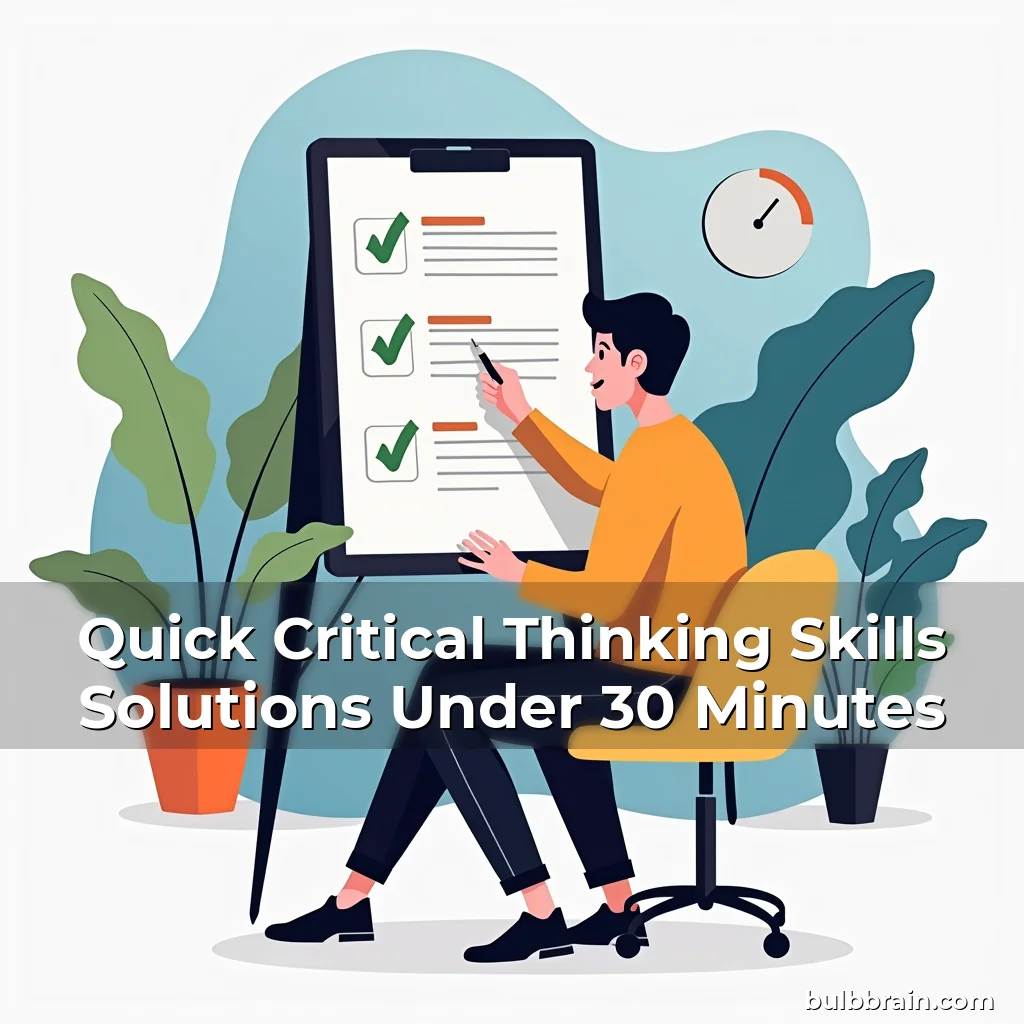
Quick Critical Thinking Skills Solutions Under 30 Minutes
Critical thinking is not just a skill—it’s a mindset that empowers individuals to navigate complex problems, make informed decisions, and thrive in an ever-changing world. Whether you’re tackling academic challenges, professional dilemmas, or everyday choices, honing your ability to think critically can transform how you approach life.
This guide offers practical, actionable solutions designed to elevate your critical thinking abilities in less than half an hour. By focusing on core principles, overcoming mental barriers, and leveraging effective strategies, you’ll gain the confidence to analyze situations deeply and respond thoughtfully. Let’s dive in.
Understanding the Core Principles of Critical Thinking
Critical thinking begins with recognizing that it goes beyond simply analyzing facts. It requires a commitment to objectivity, curiosity, and the willingness to question assumptions. At its heart, critical thinking is about actively evaluating information rather than passively accepting it at face value.
One foundational principle is the recognition of biases. Everyone has preconceived notions shaped by experiences, culture, and emotions. These biases can cloud judgment unless consciously acknowledged and addressed. Another key element is the emphasis on evidence-based reasoning. Instead of relying solely on intuition, critical thinkers prioritize data, research, and logical structures when forming conclusions.
Open-mindedness also plays a vital role. This doesn’t mean abandoning personal beliefs but rather being receptive to new perspectives and willing to revise opinions in light of compelling evidence. Finally, critical thinking demands clarity of purpose. Every inquiry should begin with a clear goal, whether it’s solving a problem, making a decision, or exploring an idea.
- Question Assumptions: Challenge the validity of premises before drawing conclusions. For example, ask yourself, “Is this assumption supported by reliable evidence?”
- Evaluate Evidence: Assess sources for credibility, relevance, and reliability. Cross-reference claims with independent research whenever possible.
- Avoid Emotional Bias: Separate feelings from factual analysis. Emotions can distort perception, leading to flawed judgments.
- Consider Alternatives: Explore multiple viewpoints and potential outcomes. This prevents tunnel vision and fosters creativity.
- Reflect on Outcomes: After reaching a conclusion, review the process used. What worked? What could have been improved?
Recognizing Cognitive Biases That Hinder Clear Judgment
Becoming aware of cognitive biases is essential for sharpening critical thinking. These mental shortcuts, while useful in some contexts, often lead to errors in reasoning. Identifying them allows you to mitigate their influence and make more rational decisions.
Confirmation bias, for instance, causes people to seek out information that reinforces existing beliefs while ignoring contradictory evidence. This can
Fact-checking websites like Snopes, PolitiFact, and Google’s Fact Check Tools can validate dubious statements. Additionally, checking for corroboration across multiple independent sources strengthens verification efforts. Always scrutinize dates, as outdated information may lack current context or accuracy.
Mindful consumption of media is equally important. News articles often present biased narratives, so reading diverse outlets provides balanced perspectives. When encountering viral content, pause to consider the intent behind the message—is it informing, persuading, or sensationalizing?
Cultivating Open-Mindedness and Intellectual Humility
Critical thinking thrives in environments where open-mindedness and intellectual humility prevail. While these traits seem straightforward, they require deliberate effort to nurture. Open-mindedness means remaining receptive to new ideas, even those that challenge long-held beliefs.
Intellectual humility complements this by acknowledging the limits of one’s knowledge. Rather than insisting on certainty, it embraces the possibility of being wrong. Research from the University of California found that intellectually humble individuals are more likely to engage in productive debates and adapt to changing circumstances.
- Practice Active Listening: Engage fully with others’ perspectives without interrupting or preparing counterarguments. This builds empathy and reduces defensiveness.
- Suspend Judgment Temporarily: Allow space for processing unfamiliar ideas before rejecting them outright. Ask clarifying questions instead of jumping to conclusions.
- Embrace Uncertainty: Accept that absolute answers aren’t always available. Focus on probability and risk assessment rather than binary thinking.
Practical Exercises to Sharpen Your Critical Thinking Abilities
Consistent practice is key to mastering critical thinking. Simple exercises integrated into daily routines can reinforce analytical habits. One popular method is reflective journaling, where individuals document their decision-making processes and evaluate what went well or poorly.
Puzzles and brain teasers also serve as excellent training grounds. Logic grids, riddles, and strategy games like chess or Sudoku enhance problem-solving agility. These activities force users to think step-by-step, weigh options, and anticipate consequences—all critical components of sound reasoning.
- Daily Reflection Prompts: Pose questions like, “Did my actions align with my goals?” or “Were there other ways to handle this situation?”
- Case Study Reviews: Analyze historical events, business failures, or scientific breakthroughs to learn from past successes and mistakes.
- Debate Practice: Participate in structured discussions on controversial topics. This improves argumentation skills and teaches how to construct valid counterpoints.
Mindfulness Practices That Support Critical Thought
Mental clarity is a cornerstone of effective critical thinking. Mindfulness practices, such as meditation and focused breathing, reduce distractions and enhance concentration. Studies indicate that regular mindfulness practitioners exhibit improved attention spans and reduced susceptibility to cognitive biases.
To incorporate mindfulness, set aside 10 minutes each morning for guided breathing exercises. Sit quietly, observe your breath, and let intrusive thoughts pass without judgment. Over time, this habit trains the brain to stay present and resist impulsive reactions.
Connecting Mindfulness to Decision-Making
When faced with high-stakes decisions, take a moment to ground yourself. Close your eyes, notice physical sensations, and mentally note your emotional state. This grounding technique helps separate emotional impulses from rational analysis, ensuring decisions reflect thoughtful deliberation rather than knee-jerk responses.
Additionally, practicing mindful observation during conversations enhances comprehension. Pay full attention to speakers, noting nonverbal cues and vocal inflections alongside verbal messages. This holistic awareness leads to richer understanding and more nuanced interpretations.
Leveraging Technology Tools for Better Decision Making
Technology offers innovative resources to aid critical thinking. Apps like Notion or Evernote allow users to organize ideas systematically, track progress on projects, and reference relevant documents efficiently. Such tools streamline brainstorming sessions and ensure nothing falls through the cracks.
For quantitative tasks, programs like Wolfram Alpha or Microsoft Excel enable precise data analysis. These platforms perform complex calculations automatically, freeing mental energy for interpreting results and spotting trends. However, it’s crucial to remain vigilant about data integrity—always verify inputs and outputs for accuracy.
- Note-Taking Apps: Use tools like OneNote or Obsidian to categorize notes and link related concepts for easier retrieval.
- Time Management Software: Applications like Toggl Track help allocate time effectively, preventing burnout and maintaining productivity.
- AI Assistants: Platforms like ChatGPT or Bard can assist with drafting reports, generating hypotheses, or summarizing lengthy texts. However, always corroborate AI-
- Set Micro Goals: Aim for short-term objectives, like evaluating three sources daily or asking one probing question per conversation.
- Track Progress Visually: Use charts or apps to monitor achievements. Seeing tangible results boosts motivation and reveals areas needing improvement.
Conclusion
Critical thinking is a dynamic skill that evolves with practice and intentionality. By integrating the strategies outlined—from addressing cognitive biases to leveraging technology—you can significantly enhance your capacity for reasoned analysis and effective decision-making.
Begin implementing these techniques today. Dedicate just a few minutes daily to reflecting on your thinking processes, challenging assumptions, and seeking diverse perspectives. Over time, these micro-actions compound into profound transformations in how you perceive and interact with the world. Stay curious, stay open, and let critical thinking become your most valuable asset.

news is a contributor at BulbBrain. We are committed to providing well-researched, accurate, and valuable content to our readers.
You May Also Like


About news
Passionate about learning, cognitive science, and helping people unlock their full potential.