
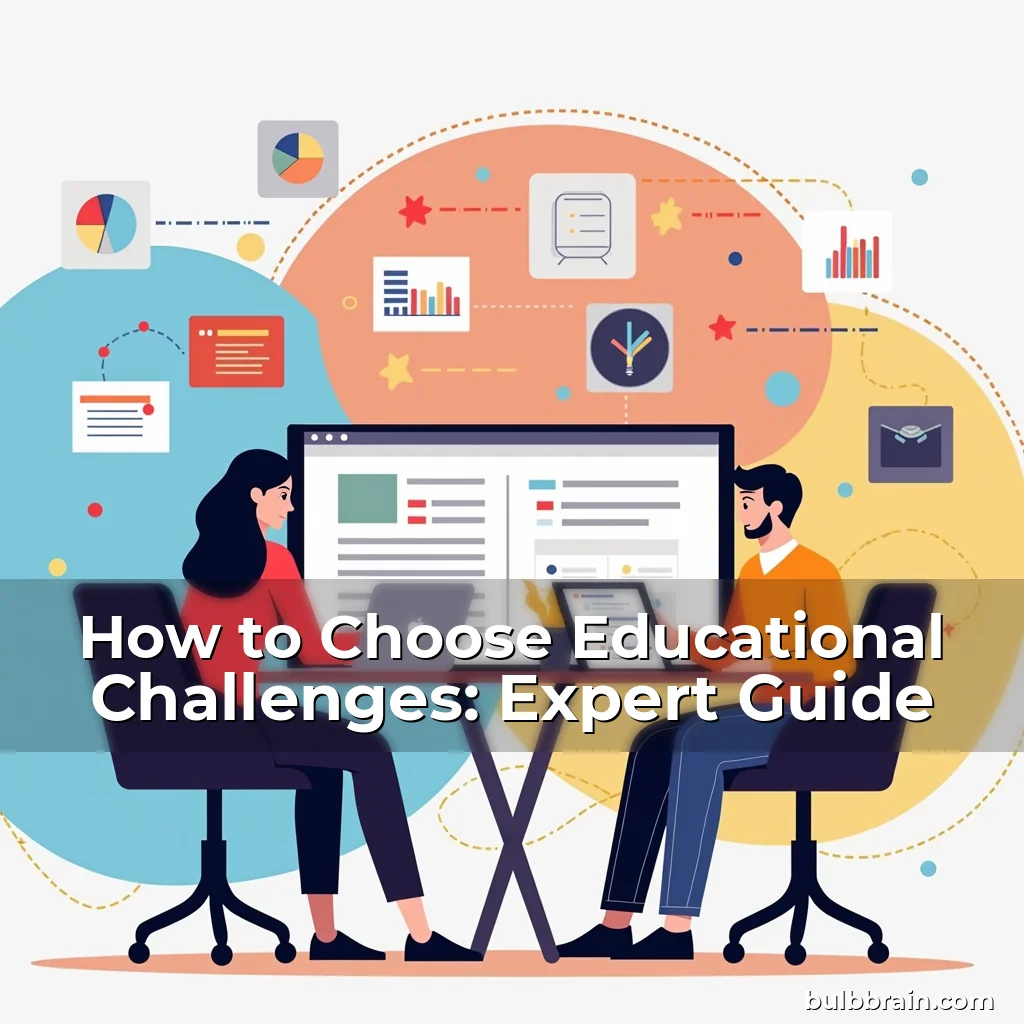
How to Choose Educational Challenges: Expert Guide
In an era where personalized learning is reshaping education systems globally, selecting appropriate educational challenges has become both an art and a science. Whether you’re a teacher designing curriculum pathways, a student seeking growth opportunities, or a parent exploring enrichment options, understanding how to choose effective challenges can unlock significant developmental benefits.
This guide provides practical frameworks for identifying meaningful educational challenges that align with individual needs while fostering critical thinking skills essential for modern learners. By examining various dimensions from cognitive complexity to emotional engagement, we’ll explore strategies to transform learning experiences into transformative journeys.
The Evolution of Educational Challenges
Educational challenges have undergone profound transformations over the past century as pedagogical theories evolved alongside technological advancements. Traditional rote memorization methods gave way to experiential learning approaches emphasizing problem-solving capabilities.
Dewey’s progressive education model, developed in the early 20th century, laid foundational principles for challenge-based learning by advocating active participation through hands-on projects. This philosophy continues to influence contemporary classroom practices worldwide.
With digital integration becoming standard in most curricula today, educational challenges now incorporate interactive elements such as gamification mechanics and real-time feedback systems. These innovations enhance learner motivation while providing immediate performance analytics.
- Cognitive Development: Modern challenges emphasize higher-order thinking skills rather than mere knowledge retention
- Adaptive Learning: Personalized difficulty levels ensure optimal engagement without overwhelming students
- Social Emotional Learning: Collaborative challenges promote teamwork and resilience-building activities
Fundamental Criteria for Selecting Effective Challenges
Choosing impactful educational challenges requires careful consideration of several key criteria that determine their effectiveness. The primary factors include alignment with learning objectives, appropriateness for skill level, and potential for long-term impact.
A well-designed challenge should clearly connect to predefined educational goals whether they relate to subject mastery, critical analysis abilities, or creative expression. Misaligned tasks may lead to superficial engagement without substantial learning outcomes.
The difficulty level must be carefully calibrated using the Zone of Proximal Development theory which suggests that ideal challenges are those that push learners slightly beyond current competencies but remain achievable with guidance.
Assessing Challenge Difficulty Levels
Research indicates that maintaining optimal challenge intensity significantly improves learning efficiency. A study published in the Journal of Educational Psychology found that students exposed to appropriately challenging material demonstrated 40% better retention rates compared to peers facing either too easy or overly complex tasks.
To assess difficulty accurately, educators should employ formative assessments before implementing new challenges. Observing baseline performance metrics allows for precise calibration of task complexity based on actual student capability levels.
Design Principles for Meaningful Educational Experiences
Creating purposeful educational challenges involves applying established design principles that maximize engagement and facilitate deep learning processes. These principles focus on creating authentic contexts, promoting autonomy, and integrating assessment naturally within the learning experience.
Authenticity enhances relevance by connecting academic concepts to real-world applications. When students see direct connections between classroom challenges and practical scenarios, intrinsic motivation tends to increase substantially.
Promoting autonomy empowers learners to take ownership of their progress. Flexible challenge structures that allow for personal choice and self-directed exploration often result in deeper conceptual understanding.
Evaluating Existing Educational Programs
Before adopting any pre-existing educational challenge program, thorough evaluation is crucial to ensure its suitability for target audiences. Key evaluation aspects include pedagogical soundness, cultural relevance, and technological compatibility.
Analyzing the theoretical foundations behind a program helps determine if its approach aligns with desired learning outcomes. Does the methodology support constructivist learning principles? Are there evidence-based research studies backing its effectiveness?
Cultural sensitivity becomes increasingly important when implementing programs across diverse populations. Content must reflect varied perspectives without reinforcing stereotypes or biases that could hinder inclusive learning environments.
Technological requirements should also be assessed for feasibility. Does the program require infrastructure not readily available in target schools? Can teachers receive adequate training to implement these tools effectively?
Tailoring Challenges for Different Learner Profiles
Recognizing individual differences among learners is essential for creating impactful educational challenges. Factors such as age, prior knowledge, learning preferences, and neurodiversity necessitate customized approaches.
Youth learners benefit from challenges incorporating play-based elements that maintain attention spans while facilitating concept acquisition. For older students, project-based learning models tend to foster deeper analytical skills development.
Learners with varying cognitive profiles require differentiated instruction techniques. Visual-spatial thinkers might excel with diagrammatic representations whereas auditory processors could benefit from narrative-driven challenges.
For neurodiverse individuals, sensory-friendly modifications and flexible pacing structures help accommodate different processing speeds and communication styles effectively.
Measuring Progress Through Educational Challenges
Effective measurement systems are vital for assessing the impact of educational challenges on learning outcomes. Multiple assessment types including formative evaluations, summative assessments, and self-reflection mechanisms provide comprehensive insight into progress tracking.
Formative assessments offer ongoing feedback during the learning process allowing timely adjustments to challenge difficulty levels. These continuous check-ins enable instructors to identify emerging difficulties promptly.
Summative assessments evaluate overall competency attainment at defined intervals. Standardized tests, portfolios, and performance tasks serve as common formats for measuring final achievement levels.
Self-assessment components empower learners to develop metacognitive awareness. Reflective journals and peer evaluations encourage introspection about personal growth trajectories.
Overcoming Common Implementation Barriers
Despite their benefits, educational challenges face several implementation barriers that can hinder successful adoption. Identifying these obstacles proactively enables strategic solutions to maintain program integrity and participant engagement.
Limited resources often pose significant constraints particularly in underfunded institutions. Creative resource allocation strategies combined with grant funding opportunities can mitigate these limitations effectively.
Teacher resistance sometimes emerges due to unfamiliar teaching methodologies. Professional development workshops focusing on gradual implementation phases typically ease transition periods successfully.
Student disengagement may occur if challenges lack perceived value or relevance. Connecting assignments explicitly to future career paths or societal issues frequently increases motivational factors.
Future Directions in Educational Challenges
Ongoing advancements in technology continue shaping the evolution of educational challenges towards more immersive and adaptive learning experiences. Emerging trends suggest increased use of artificial intelligence and virtual reality in developing dynamic instructional materials.
AI-powered platforms promise to deliver personalized challenge recommendations based on real-time performance data. These intelligent systems can dynamically adjust task complexities ensuring sustained engagement levels throughout learning cycles.
Virtual reality environments open new possibilities for experiential learning by simulating realistic scenarios that demand application of theoretical knowledge. Such immersive experiences enhance comprehension through contextualized practice.
As global collaboration intensifies, cross-cultural educational challenges will gain prominence. International partnerships enable sharing best practices while addressing shared educational priorities through joint initiatives.
Conclusion
Selecting effective educational challenges requires thoughtful consideration of multiple interrelated factors ranging from cognitive development to technological integration. Successful implementations hinge upon aligning challenge designs with specific learning objectives while maintaining adaptability to evolving circumstances.
To maximize the potential of educational challenges, practitioners should embrace continuous improvement mindsets. Regularly reviewing program efficacy through comprehensive assessments ensures that interventions remain relevant and beneficial for participants across diverse backgrounds and contexts.

news is a contributor at BulbBrain. We are committed to providing well-researched, accurate, and valuable content to our readers.
You May Also Like
About news
Passionate about learning, cognitive science, and helping people unlock their full potential.