
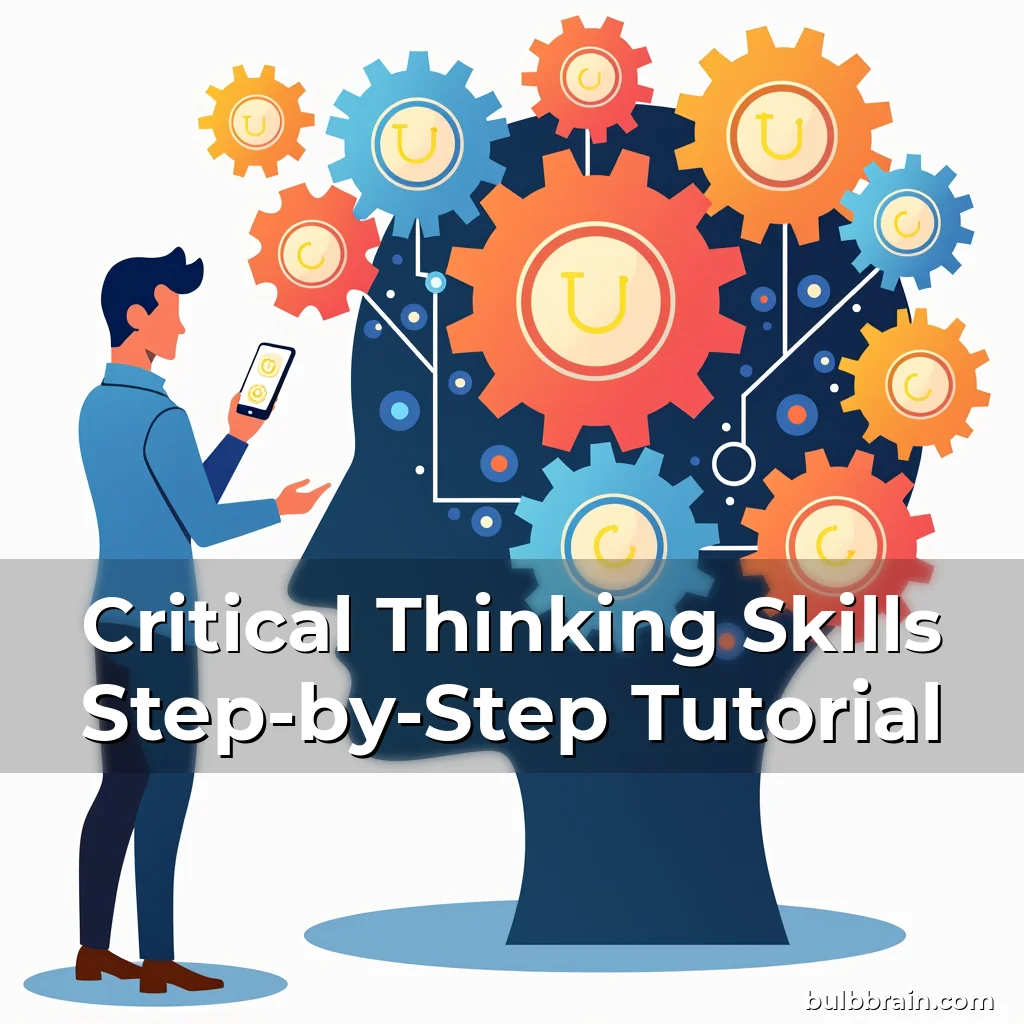
Critical Thinking Skills Step-by-Step Tutorial
Critical thinking is the cornerstone of effective problem-solving, informed decision-making, and intellectual growth. In a world saturated with information, misinformation, and complex challenges, mastering critical thinking isn’t just beneficial—it’s essential. Whether you’re navigating personal dilemmas, academic pursuits, or professional responsibilities, strong critical thinking skills empower you to analyze situations objectively and arrive at well-reasoned conclusions.
This step-by-step guide explores the principles of critical thinking, practical strategies for development, and real-world applications. By dissecting core concepts, common pitfalls, and techniques used by experts, we’ll equip you with tools to sharpen your analytical abilities and foster independent thought. Ready to transform the way you think?
Understanding Critical Thinking Fundamentals
Critical thinking begins with recognizing what it truly means. At its core, it involves evaluating facts, questioning assumptions, and forming reasoned judgments. Unlike passive acceptance of information, critical thinking demands active engagement with ideas, evidence, and logic. It’s a skill that transcends disciplines, influencing everything from scientific research to everyday choices.
The foundation of critical thinking lies in curiosity and openness. A critical thinker doesn’t assume answers are fixed; instead, they seek out multiple perspectives and scrutinize sources meticulously. This mindset encourages exploration rather than conformity, fostering innovation and resilience in the face of uncertainty.
To build this skillset, it’s crucial to distinguish between subjective opinions and objective truths. While emotions and biases inevitably influence human judgment, critical thinkers strive to minimize their impact through structured analysis. They ask questions like, “What is the evidence?” or “Is this source reliable?” before drawing conclusions.
- Evaluating Evidence: Assess the credibility, relevance, and sufficiency of information before accepting it as fact. Cross-check claims against reputable sources whenever possible.
- Identifying Assumptions: Recognize hidden premises underlying arguments. Ask yourself, “Am I assuming this is true without proof?”
- Analyzing Logic: Scrutinize the structure of arguments for fallacies, inconsistencies, or unsupported leaps. Logical flaws often undermine even well-intentioned conclusions.
The Building Blocks of Strong Analytical Abilities
Developing critical thinking requires cultivating foundational cognitive habits. One such habit is reflective observation—the practice of pausing to consider alternative viewpoints before reacting impulsively. This deliberate approach prevents knee-jerk responses and promotes thoughtful evaluation of scenarios.
Another key component is metacognition, or awareness of one’s own thought processes. Skilled critical thinkers regularly reflect on how they arrived at decisions, identifying patterns in their reasoning and areas needing improvement. Tools like journaling or self-assessment frameworks can aid in tracking progress over time.
Cognitive flexibility plays an equally vital role. Being able to adapt thinking styles based on context allows individuals to navigate diverse problems effectively. For example, analyzing financial risks may require quantitative rigor, whereas assessing ethical dilemmas calls for empathetic consideration of stakeholders’ values.
How Expert Thinkers Approach Problems Differently
A study published in the Journal of Educational Psychology found that high-performing students consistently employed systematic approaches when tackling unfamiliar tasks. These learners broke down problems into smaller components, prioritized relevant information, and tested hypotheses methodically—traits closely aligned with critical thinking practices.
In contrast, novices often rely on surface-level cues or preconceived notions, leading to flawed solutions. The difference highlights why intentional training in analytical methods yields significant improvements in problem-solving performance. Experts emphasize the importance of slowing down initial reactions to avoid confirmation bias.
Mental Frameworks to Enhance Reasoning Capacity
Applying structured models can significantly boost critical thinking effectiveness. One widely used framework is the Socratic Method, which employs open-ended questions to probe deeper understandings of issues. By challenging simplistic interpretations, this technique fosters nuanced perspectives and reveals gaps in knowledge.
Another powerful tool is the SWOT Analysis—a strategic assessment of Strengths, Weaknesses, Opportunities, and Threats. Originally developed for business contexts, it provides a holistic view of any situation, helping identify internal capabilities versus external factors affecting outcomes. This balance ensures decisions account for both controllable and uncontrollable variables.
The Feynman Technique offers yet another compelling strategy. Named after physicist Richard Feynman, this approach involves explaining complex concepts in simple language to test comprehension. When faced with difficult material, attempting to teach it to someone else forces clarification of misunderstandings and reinforces learning.
Common Cognitive Biases and How to Mitigate Them
While critical thinking aims for objectivity, humans naturally experience cognitive distortions known as heuristics. Confirmation bias, for instance, leads people to favor information aligning with existing beliefs, potentially skewing analyses. Awareness alone isn’t enough—structured countermeasures are required.
One proven mitigation tactic is adopting devil’s advocate roles during discussions. Actively seeking opposing views compels the mind to consider alternatives beyond comfort zones. Research indicates this practice enhances decision quality by exposing blind spots in reasoning processes.
Survivorship bias presents another challenge, focusing disproportionately on successes while ignoring failures. To combat this, analysts should examine both positive and negative outcomes systematically. Comparing historical case studies where attempts failed alongside those that succeeded provides balanced insights.
Cultivating Intellectual Courage Through Practice
Growth in critical thinking hinges on consistent application. Begin by deliberately selecting one area of interest and applying analytical frameworks daily. Over time, these exercises become intuitive, shaping default response patterns toward more rigorous examination of inputs.
Varying subject matter is equally important. Exposing oneself to interdisciplinary topics builds transferable skills applicable across domains. Engaging with literature, science, philosophy, or mathematics broadens conceptual toolkits and improves pattern recognition abilities.
Collaborative environments accelerate development too. Participating in debate clubs, online forums, or peer review sessions exposes individuals to diverse viewpoints while refining articulation of thoughts. Constructive feedback loop systems enable continuous refinement of analytical approaches.
Measuring Progress in Critical Thinking Development
Tracking advancement requires defined metrics. One indicator is increased ability to detect logical fallacies in media consumption or public discourse. Noticing instances where arguments lack sufficient evidence signals improved discernment capacities.
Self-assessments using standardized rubrics provide quantifiable benchmarks. Many educational institutions offer free critical thinking assessments measuring skills like inference capability, argumentation strength, and hypothesis testing proficiency. Regular evaluations highlight progress trajectories.
Performance gains manifest tangibly in real-life outcomes too. Improved grades, better workplace recommendations, or enhanced negotiation skills demonstrate practical impacts of cultivated critical thinking competencies. Celebrate incremental victories along the journey!
Navigating Complex Decisions With Precision
Complex decisions demand layered scrutiny involving multiple dimensions. Begin by clearly defining objectives—what exactly constitutes success? Establishing concrete criteria guides evaluation of options meaningfully. Vague goals lead to ambiguous outcomes, undermining decision efficacy.
Scenario modeling becomes invaluable when facing uncertain futures. Creating hypothetical situations based on different assumptions allows anticipation of potential consequences. This proactive stance enables preparation for contingencies and reduces reliance on reactive measures later.
Risk assessment matrices visualize trade-offs between competing priorities. Plotting probability vs. impact scores clarifies which uncertainties warrant immediate attention versus those posing lower threats. Such visualizations facilitate prioritization amid limited resources.
Case Studies Illustrating Effective Decision-Making
During the early stages of the pandemic, healthcare professionals utilized predictive analytics combined with epidemiological data to allocate scarce medical supplies efficiently. Their models incorporated variables like infection rates, hospital capacity, and demographic vulnerabilities—an exemplar of multidisciplinary critical thinking applied under pressure.
Business leaders adapting to remote work transitions showcased similar analytical prowess. Companies implementing flexible policies analyzed employee productivity metrics, cybersecurity implications, and cultural adaptation factors simultaneously. Balancing technological feasibility with human capital considerations demonstrated sophisticated risk management.
Even personal finance decisions benefit from structured analysis. When considering investment opportunities, examining historical returns, volatility levels, diversification strategies, and alignment with long-term goals
Techniques to Maintain Mental Agility
Cross-training minds through diverse activities strengthens neural pathways associated with critical thinking. Alternate between creative projects requiring imaginative solutions and analytical puzzles demanding precise calculations. This balance preserves cognitive versatility amidst specialized training efforts.
Physical exercise complements mental exertion beautifully. Aerobic activity increases brain-derived neurotrophic factor (BDNF), enhancing synaptic plasticity linked to memory retention and problem-solving speed. Even brief walks can rejuvenate concentration levels post-intensive analytical sessions.
Mindfulness meditation sharpens focus and emotional regulation, both crucial for sustained critical thinking. Allocating ten minutes daily to mindful breathing cultivates present-moment awareness, reducing distractions and improving overall cognitive efficiency.
Overcoming Barriers to Clear Thought Processes
Emotional reactivity poses substantial hurdles to rational analysis. Stress hormones like cortisol impair executive functioning, clouding judgment and narrowing perceptual scope. Developing emotional intelligence enables healthier navigation of turbulent situations without compromising analytical acumen.
Social pressures often encourage conformity over contemplation. Peer validation mechanisms sometimes discourage dissenting opinions, stifling genuine inquiry. Countering this requires building inner conviction rooted in personal standards rather than external approval-seeking behaviors.
Time constraints frequently compromise thorough analysis. Rushed decisions tend to prioritize expediency over accuracy. Implementing time-boxing techniques allocates focused intervals specifically for deep thinking, preventing hasty conclusions arising from incomplete information processing.
Strategies for Managing Cognitive Load Effectively
Prioritizing tasks based on urgency and significance optimizes mental energy allocation. Eisenhower Matrix categorizations help determine which activities merit immediate attention versus those best deferred. This distinction prevents overwhelm from simultaneous demands on limited cognitive bandwidth.
Chunking information simplifies complex material by grouping related concepts together. Creating mnemonics or concept maps transforms abstract ideas into digestible formats, facilitating recall and integration of multifaceted topics.
Leveraging digital tools streamlines organization efforts. Task management apps, note-taking platforms, and calendar integrations automate routine administrative duties, freeing up mental space for higher-order analytical functions.
Fostering Independent Judgment in Everyday Life
Critical thinking empowers individuals to resist undue influence from authority figures, advertisements, or social norms. Questioning narratives presented uncritically develops resistance to manipulation tactics commonly exploited in marketing campaigns and political rhetoric.
Consumer literacy becomes increasingly vital as technology evolves rapidly. Understanding algorithmic filtering effects, privacy concerns, and subscription models equips users to make informed digital choices rather than passively consuming whatever platforms choose to show them.
Parental guidance remains crucial for youth development. Teaching children to evaluate news stories critically prepares them for adulthood’s informational complexities. Modeling respectful disagreement demonstrates healthy ways to engage with differing perspectives constructively.
Real-World Applications Beyond Academia
Healthcare professionals apply critical thinking constantly when diagnosing patients. Evaluating symptoms holistically, cross-referencing diagnostic tests, and weighing treatment options necessitates meticulous analytical precision. Missteps carry serious consequences, underscoring the stakes involved.
Legal practitioners similarly depend on rigorous evidentiary review. Interpreting statutes accurately, constructing coherent legal arguments, and anticipating judicial objections require exceptional analytical capabilities honed through years of disciplined study and practice.
Entrepreneurs utilize critical thinking in market analysis, product development, and crisis management. Identifying unmet consumer needs, forecasting industry trends, and pivoting strategies mid-course all hinge on robust analytical frameworks guiding business operations.
Conclusion
Critical thinking is not merely an academic pursuit but a lifelong discipline that enriches all facets of existence. From personal relationships to global citizenship, the ability to analyze, question, and synthesize information profoundly shapes our worldview and actions.
By embracing the step-by-step journey outlined above—you’ve taken the first essential step towards transforming your thought processes. Commit to practicing these skills daily, remain curious about the unknown, and never cease questioning the status quo. Your future self will thank you for nurturing this most valuable asset.

news is a contributor at BulbBrain. We are committed to providing well-researched, accurate, and valuable content to our readers.
You May Also Like

About news
Passionate about learning, cognitive science, and helping people unlock their full potential.