
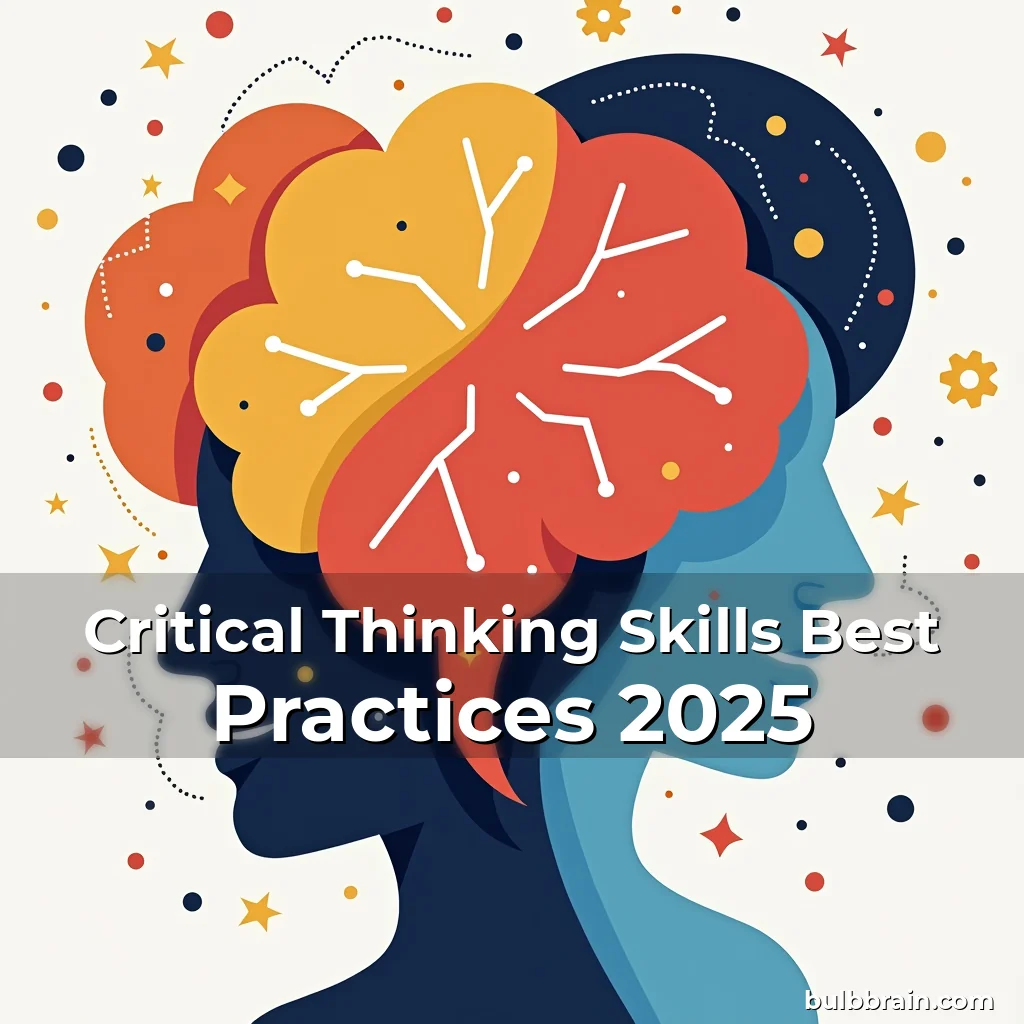
Critical Thinking Skills Best Practices 2025
In an era defined by rapid technological change, information overload, and complex global challenges, mastering critical thinking skills has become essential for success. These skills empower individuals to analyze problems deeply, question assumptions, and make informed decisions across all areas of life.
From academic pursuits to career advancement and everyday choices, critical thinking is the foundation of effective problem-solving. This article explores proven strategies, tools, and practices to sharpen your ability to think critically in 2025 and beyond.
The Core Components of Critical Thinking
Critical thinking involves analyzing information objectively and making reasoned judgments. It requires moving beyond surface-level observations to explore underlying causes, patterns, and potential consequences. This process demands curiosity, intellectual humility, and a commitment to evidence-based reasoning.
At its heart, critical thinking combines analytical and evaluative skills. Individuals must assess the credibility of sources, identify biases, and distinguish correlation from causation. For example, recognizing whether a claim is supported by data or influenced by emotion helps avoid misleading conclusions.
- Analytical Reasoning: Breaking down complex issues into smaller parts to understand their interrelationships.
- Evaluative Judgment: Assessing the quality of arguments, evidence, and solutions based on criteria like relevance and reliability.
- Synthetic Thinking: Combining insights from multiple perspectives to create innovative approaches to problems.
Why Critical Thinking Matters Now More Than Ever
The rise of artificial intelligence, social media algorithms, and disinformation campaigns has amplified the need for strong critical thinking abilities. Misleading narratives spread rapidly, often outpacing efforts to verify accuracy. Without robust critical thinking, individuals risk falling prey to manipulation or flawed decision-making.
Professionally, industries increasingly demand employees who can navigate ambiguity, adapt to change, and solve non-routine problems. Companies prioritize candidates who demonstrate critical thinking during interviews, emphasizing skills like creativity, resilience, and ethical judgment.
Data-Driven Insights on Cognitive Biases
Research reveals that humans are prone to cognitive biases, which distort perception and reasoning. Studies show that up to 90% of decisions involve subconscious biases, leading to errors in judgment. Understanding these biases is the first step toward mitigating their impact.
Common biases include confirmation bias, anchoring effect, and availability heuristic. For instance, confirmation bias leads people to favor information that aligns with existing beliefs while dismissing contradictory evidence. Recognizing these tendencies allows for intentional correction in thought processes.
Strategies to Develop Stronger Critical Thinking Habits
Cultivating critical thinking is a lifelong journey requiring deliberate practice. Begin by challenging yourself to ask deeper questions whenever encountering new information. Instead of accepting claims at face value, investigate their origins and supporting evidence.
Engage in activities that promote divergent thinking, such as brainstorming sessions, creative writing, or strategic games. These exercises encourage exploring multiple solutions rather than settling for familiar answers. Over time, this flexibility becomes a natural response to complex situations.
- Question Assumptions: Regularly interrogate the premises behind statements, including your own beliefs.
- Seek Diverse Perspectives: Expose yourself to ideas and cultures different from your own to broaden understanding.
- Prioritize Evidence: Evaluate claims by examining available data, peer-reviewed studies, and expert consensus.
The Role of Education in Shaping Critical Thinkers
Modern education systems are gradually shifting toward fostering critical thinking instead of rote memorization. Institutions emphasize projects that require students to synthesize knowledge, debate topics, and present arguments supported by research. These methods mirror real-world scenarios demanding analytical rigor.
Critically engaged learners benefit from educators trained to guide reflective discussions. Teachers who pose provocative questions and encourage student-led investigations cultivate environments conducive to deep learning. Such classrooms produce graduates capable of tackling interdisciplinary challenges.
Trends in Educational Technology Enhancing Critical Thinking
Digital tools are transforming how critical thinking is taught and practiced. Adaptive learning software provides personalized feedback, helping users identify gaps in their reasoning skills. Virtual simulations allow students to test theories safely before applying them in real-life contexts.
Platforms offering interactive case studies enable learners to simulate problem-solving scenarios commonly encountered in fields like medicine, law, and engineering. Gamified learning experiences increase engagement while reinforcing analytical capabilities through repeated exposure.
Professional Applications of Critical Thinking Across Industries
Healthcare professionals rely heavily on critical thinking to diagnose patients accurately. Doctors must interpret symptoms, evaluate medical history, and consider treatment options—all while remaining alert to diagnostic errors. Similarly, engineers use systematic analysis to design safe infrastructure that meets evolving standards.
Business leaders employ critical thinking to navigate market fluctuations, assess investment opportunities, and manage organizational risks. Effective leadership involves weighing long-term impacts against immediate gains, ensuring sustainable growth without compromising ethical values.
Overcoming Obstacles to Critical Thinking Development
Many barriers prevent individuals from fully developing critical thinking capacities. Fear of failure, resistance to criticism, and lack of confidence hinder exploration of alternative viewpoints. Creating a supportive environment free from judgment encourages experimentation and growth.
Time constraints also challenge consistent practice of critical thinking. Integrating micro-learning moments into daily routines—such as reflecting on a single issue each morning—can maintain momentum toward skill development. Tracking progress through journals further reinforces learning achievements.
Critical Thinking in Everyday Life Scenarios
From managing personal finances to resolving interpersonal conflicts, critical thinking plays a pivotal role in daily living. When deciding whether to rent or buy property, analyzing interest rates, maintenance costs, and future financial goals prevents costly mistakes. Similarly, addressing disagreements with loved ones requires understanding emotions alongside factual considerations.
Habitual application of critical thinking enhances overall life satisfaction. People who approach decisions methodically experience fewer regrets because they’ve thoroughly evaluated alternatives beforehand. This proactive mindset fosters resilience during unexpected events.
Fostering Critical Thinking Through Community Engagement
Participating in group debates, civic forums, or volunteer work offers excellent opportunities to hone critical thinking skills. Engaging with others having differing views improves tolerance for complexity and strengthens argumentation abilities. Collaborative problem-solving promotes shared responsibility and collective wisdom.
Making time for meaningful conversations with peers across disciplines exposes individuals to novel ways of thinking. Whether discussing scientific breakthroughs or artistic interpretations, these exchanges stimulate intellectual curiosity and expand mental horizons.
Measuring Progress in Critical Thinking Growth
Assessing improvements in critical thinking requires self-awareness combined with objective benchmarks. Reflective journaling captures changes in thought patterns over time, highlighting increased openness to uncertainty or reduced reliance on assumptions. Seeking external evaluations through mentorship programs adds additional perspective.
Benchmarking performance against established frameworks assists in identifying strengths and weaknesses. Tools measuring analytical depth, argument clarity, and solution effectiveness provide quantifiable metrics useful for targeted development plans.
Conclusion
Critical thinking remains vital for navigating modern complexities—from combating misinformation to driving innovation. By embracing structured practices, leveraging technology, and engaging constructively with communities, anyone can significantly enhance these crucial competencies.
To begin strengthening your critical thinking abilities today, commit to regularly questioning information, exploring opposing viewpoints, and refining your reasoning processes. Small steps taken consistently yield substantial long-term results.

news is a contributor at BulbBrain. We are committed to providing well-researched, accurate, and valuable content to our readers.
You May Also Like

About news
Passionate about learning, cognitive science, and helping people unlock their full potential.