
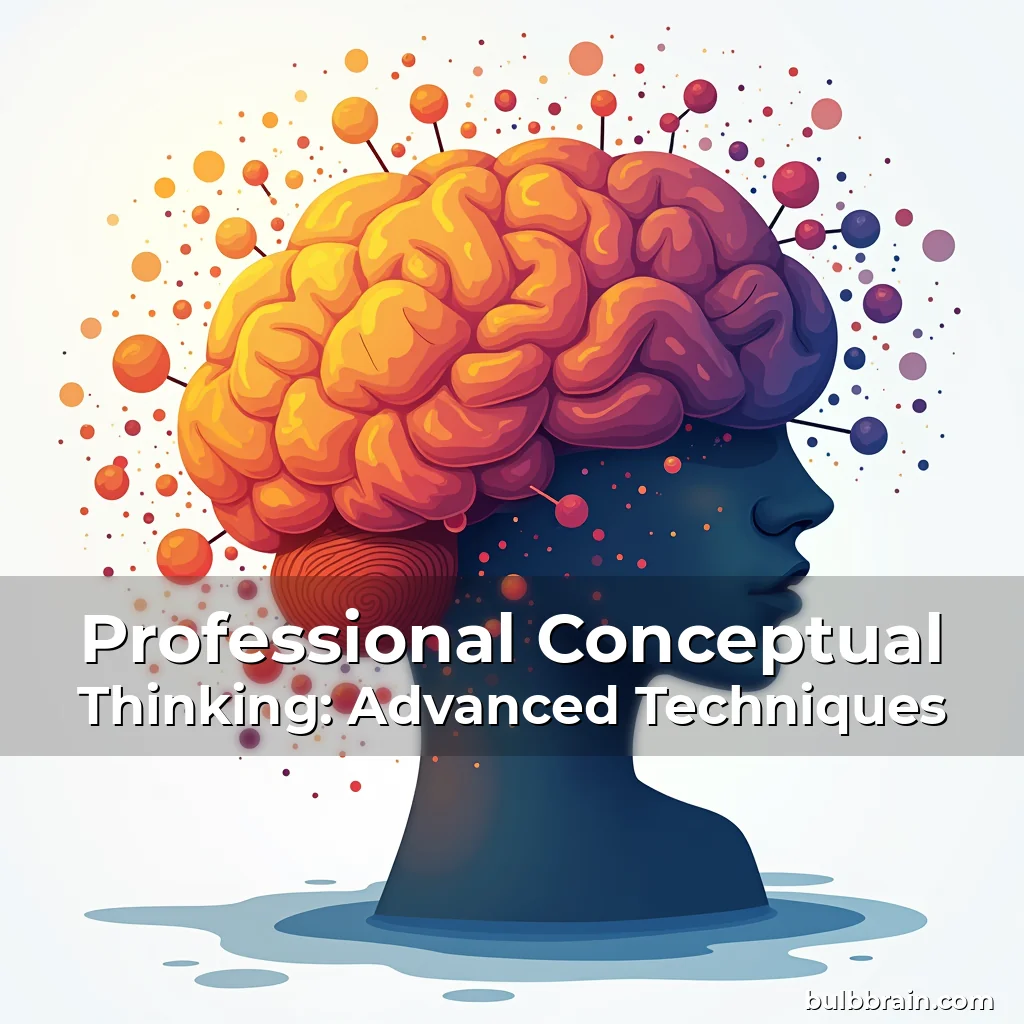
Professional Conceptual Thinking: Advanced Techniques
In today’s fast-paced world, the ability to think beyond surface-level details and grasp underlying patterns is becoming increasingly vital. This skill, known as conceptual thinking, empowers individuals to solve problems creatively, innovate effectively, and navigate complexity with clarity.
Conceptual thinking isn’t limited to professionals; it benefits everyone seeking deeper understanding and meaningful progress. Whether you’re tackling business challenges, scientific puzzles, or personal goals, mastering this mindset unlocks transformative potential.
The Foundation of Conceptual Thinking
At its core, conceptual thinking involves identifying abstract relationships, principles, and structures that govern phenomena. Unlike analytical thinking, which focuses on dissecting components, conceptual thinking synthesizes parts into broader frameworks.
This approach requires mental flexibility, curiosity, and the courage to question assumptions. By shifting perspective, you can uncover connections others overlook, leading to breakthrough solutions.
Experts emphasize that conceptual thinkers thrive in ambiguity, seeing uncertainty as an opportunity rather than a barrier. Their minds are trained to recognize patterns in chaos and derive meaning from complexity.
Cultivating this mindset begins with deliberate practice. Engaging with diverse disciplines—from philosophy to design—expands cognitive horizons, fostering interdisciplinary insight.
- Identify Core Principles: Focus on fundamental truths rather than peripheral details. For example, instead of memorizing facts about climate change, understand the systemic drivers behind environmental shifts.
- Pursue Analogous Frameworks: Apply models from unrelated domains to gain fresh perspectives. A musician might borrow structural theories from architecture to compose innovative symphonies.
Advanced Strategies for Developing Conceptual Skills
Mastering conceptual thinking demands intentional effort. One effective strategy is “reverse engineering” ideas—to break down established systems and rebuild them with novel configurations.
Another technique is adopting first-person narratives for complex subjects. Imagining yourself inside a process or system deepens comprehension and reveals hidden dynamics.
Sometimes, stepping away from a challenge allows subconscious processing to
Research shows that metaphoric thinking enhances memory retention and facilitates communication across disciplines. Engineers often use mechanical metaphors to explain software architectures.
However, overreliance on clichéd comparisons can limit creativity. Striving for original analogies ensures your conceptual framework remains dynamic and relevant.
Creative writers frequently employ metaphorical thinking to craft compelling stories, demonstrating how this skill transcends academic contexts into everyday expression.
Navigating Cognitive Biases in Conceptual Analysis
Even skilled conceptual thinkers encounter biases that distort perception. Confirmation bias, for instance, leads us to favor information aligning with preexisting beliefs, potentially missing critical nuances.
Overcoming these barriers requires conscious awareness and structured questioning. Asking “What evidence contradicts my current view?” forces reevaluation of assumptions.
Diversifying input sources is another defense against biased thinking. Exposure to conflicting viewpoints strengthens the ability to synthesize contradictory data into unified concepts.
Regular reflection sessions help identify recurring blind spots. Journaling about decision-making processes uncovers unconscious patterns hindering objective analysis.
Applying Conceptual Thinking Across Disciplines
In business, conceptual thinking drives innovation by spotting market trends obscured by noise. Entrepreneurs who anticipate industry evolutions outperform competitors focused solely on immediate gains.
Scientists leverage conceptual frameworks to develop groundbreaking theories. Einstein’s relativity emerged from challenging Newtonian paradigms, illustrating the power of paradigm-shifting thinking.
Educators benefit from conceptual instruction methods that prioritize understanding over rote memorization. Teaching mathematics through real-world applications fosters deeper engagement and long-term mastery.
Artists exemplify conceptual thinking in creating multidimensional works that invite interpretation. Abstract paintings provoke emotional responses by distilling complex themes into visual forms.
Case Study: Redefining Urban Mobility
A city facing traffic congestion employed conceptual thinking to reimagine transportation infrastructure. Instead of widening roads—a conventional solution—they developed integrated public transit networks prioritizing efficiency over expansion.
This shift required viewing mobility as a system rather than isolated components. Planners mapped behavioral patterns, economic factors, and technological possibilities to design holistic solutions.
The result was reduced emissions, improved accessibility, and increased rider satisfaction. This success highlights how conceptual frameworks yield sustainable outcomes where traditional approaches fail.
Such examples demonstrate that conceptual thinking transforms seemingly insurmountable problems into opportunities for reinvention and growth.
Fostering Collaborative Conceptual Environments
Organizations cultivating conceptual cultures encourage cross-functional teams to share expertise freely. Diverse backgrounds stimulate richer discussions and unconventional problem-solving approaches.
Leaders play a pivotal role by modeling open-mindedness and rewarding risk-taking. Creating safe spaces for experimentation promotes psychological safety essential for radical idea generation.
Structured brainstorming techniques, like SCAMPER or Six Thinking Hats, guide groups toward divergent thinking. These frameworks prevent premature convergence on obvious solutions.
Technology platforms facilitate virtual collaboration, enabling global teams to contribute insights regardless of physical location. Cloud-based whiteboards support real-time conceptual exploration.
Measuring Progress in Conceptual Development
Tracking improvements in conceptual thinking requires qualitative metrics. Self-assessment tools measuring pattern recognition abilities, hypothesis formulation speed, and analogy creation frequency provide useful benchmarks.
Feedback loops from peers and mentors offer external validation of growth areas. Regular performance reviews focusing on intellectual agility rather than rigid outputs foster continuous development.
Data analytics can quantify conceptual maturity by evaluating the number of interconnected ideas generated versus linear thinking. This metric reflects the capacity for synthesis and innovation.
Longitudinal studies show that consistent conceptual training correlates with enhanced career advancement and leadership effectiveness over time.
Future Trends in Conceptual Thought
As artificial intelligence evolves, human conceptual thinking becomes even more critical. Machines excel at pattern recognition but lack the contextual understanding and ethical judgment inherent in human cognition.
Emerging technologies demand new conceptual frameworks. Quantum computing necessitates reimagining computational logic itself, requiring experts to think beyond classical paradigms.
Educational institutions are adapting curricula to nurture conceptual competencies explicitly. Interdisciplinary programs combining STEM with humanities prepare students for future complexities.
Global challenges like climate change require transnational conceptual cooperation. Shared frameworks enable nations to coordinate efforts despite cultural and political differences.
Cultivating Lifelong Conceptual Growth
Lifelong learners embrace conceptual thinking as an ongoing journey rather than a finite goal. Reading widely across genres maintains mental elasticity, preventing intellectual stagnation.
Engaging in Socratic dialogues sharpens analytical precision while expanding worldview perspectives. Questioning deeply and listening actively enriches conceptual depth.
Volunteering in unfamiliar environments exposes individuals to alternative ways of thinking. Cultural immersion broadens conceptual boundaries and fosters empathy-driven solutions.
Embracing failure as a learning tool accelerates conceptual maturation. Every misstep provides valuable feedback about assumptions and limitations in current thinking models.
Conclusion
Conceptual thinking equips individuals to tackle tomorrow’s challenges with wisdom born from deep understanding. Its value extends far beyond academic settings into every facet of life and work.
To begin your journey, commit to daily exercises that stretch your mental boundaries—whether exploring philosophical texts, experimenting with creative projects, or re-evaluating old assumptions. With persistence, conceptual fluency will become second nature, opening doors to unprecedented achievements.

news is a contributor at BulbBrain. We are committed to providing well-researched, accurate, and valuable content to our readers.
You May Also Like
About news
Passionate about learning, cognitive science, and helping people unlock their full potential.