You are currently viewing Microsoft study claims AI reduces critical thinking
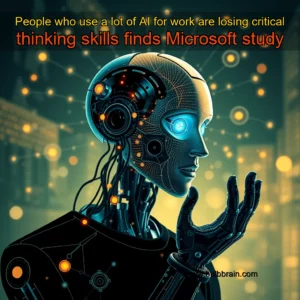
Representation image: This image is an artistic interpretation related to the article theme.

Microsoft study claims AI reduces critical thinking

Overreliance on AI tools erodes critical thinking skills.

The participants were then asked to complete a series of cognitive tasks that tested their critical thinking skills.

The Study’s Findings

The study found that the more participants used AI tools, the less they relied on their critical thinking skills. This is a concerning trend, as critical thinking is a crucial skill for problem-solving and decision-making in the workplace.

The Impact on Critical Thinking

  • The study found that participants who used AI tools for data analysis and decision-making reported lower levels of critical thinking skills compared to those who did not use AI tools. The use of AI tools was associated with a decrease in the ability to think creatively and make novel connections between seemingly unrelated ideas. Participants who used AI tools also reported feeling less confident in their ability to make decisions and solve problems. ## The Implications of the Study*
  • The Implications of the Study

    The findings of this study have significant implications for the way we work and the skills we use in the workplace.

    They were able to create more innovative and effective solutions by working closely with the AI.

    The Power of Human-AI Collaboration

    The relationship between humans and artificial intelligence (AI) has been a topic of interest for many years. While some people view AI as a threat to human jobs, others see it as a powerful tool that can augment human capabilities and enhance productivity. In a recent study, researchers found that when humans and AI work together, the results are often more innovative and effective than when humans work alone.

    The Benefits of Human-AI Collaboration

  • Improved accuracy: AI can process large amounts of data quickly and accurately, but it can also make mistakes. Humans can review and correct AI-generated results, ensuring that the final output is accurate and reliable. Increased creativity: AI can generate ideas and suggestions, but it often lacks the creativity and intuition that humans take for granted. By working together, humans can build on AI-generated ideas and create something truly innovative. Enhanced productivity: AI can automate repetitive tasks, freeing up humans to focus on more complex and creative work. This can lead to significant productivity gains and improved work quality. ## A Study on Human-AI Collaboration**
  • A Study on Human-AI Collaboration

    In a recent study, researchers from the University of California, Berkeley, conducted an experiment to test the benefits of human-AI collaboration. The study involved 100 participants who were divided into two groups: one group worked alone on a task, while the other group worked with an AI system.

    The Results

  • Improved accuracy: The group that worked with the AI system achieved higher accuracy rates than the group that worked alone.
  • Leave a Reply