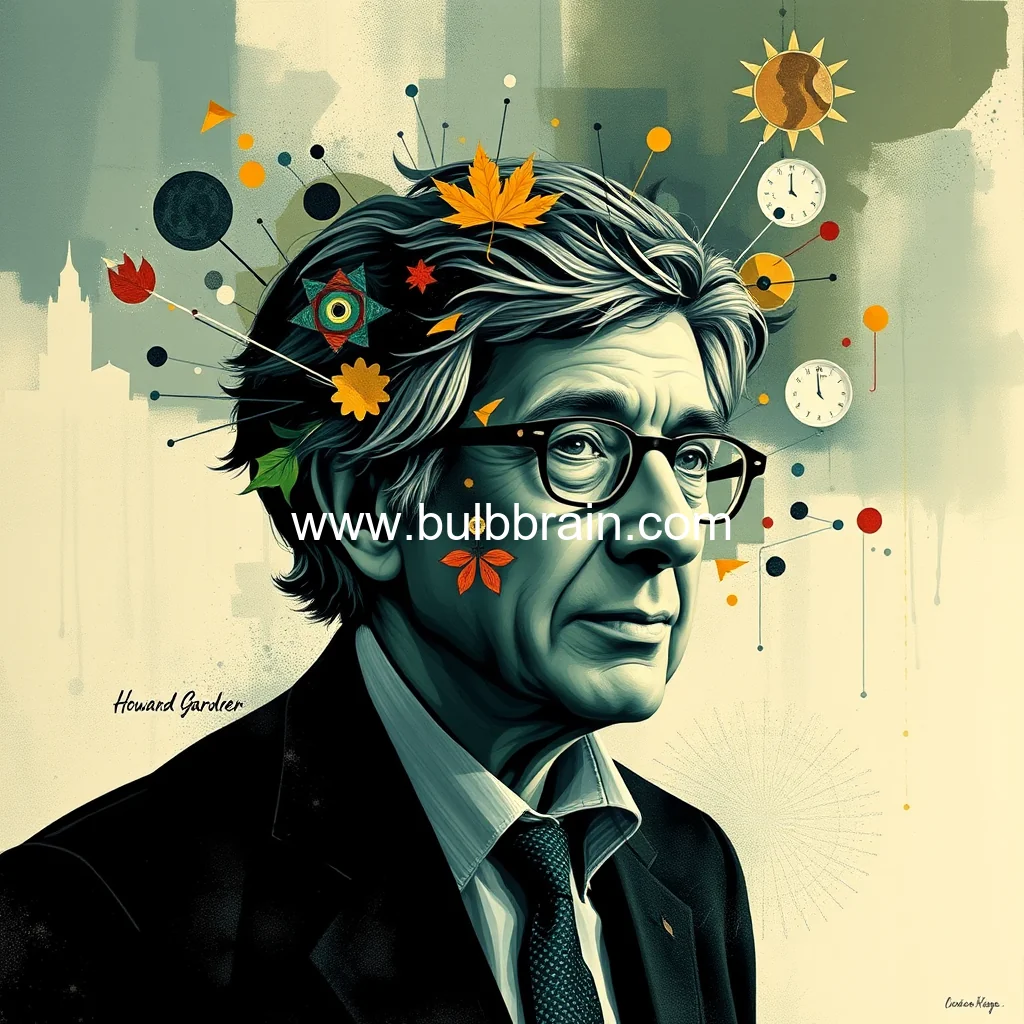
His work focuses on multiple intelligences theory, which posits that there are multiple types of intelligence, rather than a single, general intelligence.
The Multiple Intelligences Theory
Gardner’s theory challenges the traditional view that there is only one type of intelligence, as proposed by Howard Gardner’s work on multiple intelligences theory. This theory suggests that there are multiple types of intelligence, each with its own unique characteristics and strengths.
The Life and Work of Howard Gardner
Howard Gardner is a renowned American psychologist and educator. He is best known for his theory of multiple intelligences, which suggests that people have different types of intelligence that are not necessarily measured by traditional IQ tests. Gardner’s work has had a significant impact on education and has influenced many educators and researchers.
Early Life and Education
Gardner was born in 1943 in Brooklyn, New York. He grew up in a family of modest means and was raised in a culturally diverse neighborhood. Gardner’s early education was marked by a strong emphasis on social and emotional learning, which would later influence his work on multiple intelligences.
Career
Gardner’s academic career began at Harvard University, where he earned his undergraduate degree in psychology.
Gardner’s groundbreaking theory of multiple intelligences challenges traditional views of intelligence as a single, general ability.
However, the theory has not been widely adopted by the scientific community due to its lack of empirical evidence and the complexity of its concepts.
The Origins of Gardner’s Theory of Multiple Intelligences
In 1983, Howard Gardner, a renowned psychologist, introduced his groundbreaking theory of multiple intelligences. Gardner proposed that there are not just one or two types of intelligence, but rather multiple types, each with its own unique characteristics and strengths. This theory challenged the traditional view of intelligence as a single, general ability that could be measured by IQ tests.
Key Components of Gardner’s Theory
- Linguistic intelligence
- Logical-mathematical intelligence
- Spatial intelligence
- Bodily-kinesthetic intelligence
- Musical intelligence
- Interpersonal intelligence
- Intrapersonal intelligence
- Naturalist intelligence
- Existential intelligence
Instead, we should focus on teaching them to think critically and creatively, to solve problems that require human intuition and empathy.
The Problem with Over-Reliance on Technology
In today’s digital age, it’s easy to get caught up in the idea that technology can solve all our problems. We’re constantly bombarded with messages telling us that we can outsource our work, automate our tasks, and even learn new skills through online courses. But the truth is, technology has its limitations. While it can process vast amounts of information quickly and accurately, it lacks the creativity, empathy, and critical thinking skills that humans take for granted.
The Power of Storytelling
Gardner’s work is deeply rooted in the power of storytelling. He believes that stories have the ability to shape our perceptions, influence our emotions, and even change our behavior. He argues that stories can be used to convey complex ideas and values in a way that is both engaging and accessible to a wide audience. Key points:
- • Stories have the power to shape our perceptions and influence our emotions. • Stories can convey complex ideas and values in an engaging and accessible way. • The power of storytelling is a key theme in Gardner’s work. ## The Importance of Imagination
- • Imagination is essential for creativity, innovation, and problem-solving. • Imagination allows us to think outside the box and come up with new and original ideas. • The importance of imagination is a key theme in Gardner’s work. ## The Role of the Writer
- • Writers have a responsibility to use their words to inspire, educate, and entertain. • Writers should strive to create content that is both informative and engaging.
He was particularly drawn to Goodman’s ideas on the philosophy of language and the concept of “semiotics.” Goodman’s work on the philosopher’s role in society, the importance of critical thinking, and the need for intellectual freedom resonated deeply with him.
The Influence of Nelson Goodman on His Life’s Work
Nelson Goodman’s philosophical ideas had a profound impact on the author’s life and career. His work on the philosophy of language, particularly the concept of semiotics, continues to influence his thoughts and writings to this day.
Semiotics and the Power of Language
Goodman’s concept of semiotics, which explores the relationship between signs and meaning, has had a lasting impact on the author’s understanding of language. He saw semiotics as a way to understand how language shapes our perceptions and understanding of the world. This idea has influenced his approach to writing and communication, encouraging him to think critically about the power of language. Semiotics is the study of signs and symbols and how they convey meaning. Goodman’s work on semiotics highlights the importance of understanding the relationship between signs and meaning. This understanding has influenced the author’s approach to writing and communication, encouraging him to think critically about the power of language.
The Importance of Critical Thinking and Intellectual Freedom
Goodman’s emphasis on the importance of critical thinking and intellectual freedom has also had a significant impact on the author’s life and work.
They found that people who were more humanistic were more creative. This research was later published in a book titled “Creativity: Flow and the Psychology of Discovery and Invention”.
The Early Years of Gardner’s Career
Gardner’s early career was marked by his work on the Boston Veterans Hospital’s aphasia ward.
He also mentions that he is not interested in the presidency, but is interested in the vice presidency. He also mentions that he is interested in the presidency of the United States, but only if he is not the president of the United States. This statement is confusing and has been interpreted in many ways. Garder’s statement has been the subject of much debate and discussion among scholars and the general public.
Understanding Garder’s Ambiguous Statement
Garder’s statement has been the subject of much debate and discussion among scholars and the general public. On one hand, some people interpret his statement as a clear indication that he is interested in the presidency, but only if he is not the president of the United States. On the other hand, others interpret his statement as a confusing and contradictory statement that does not provide any clear indication of his interest in the presidency.
The Ambiguity of Garder’s Statement
- Garder’s statement is ambiguous because it uses the phrase “presidency of the United States” and “president of the United States” interchangeably.
I believe that the world is a complex and difficult place, but I also believe that there is always hope for a better future.
The Power of Resilience
As a pessimist, Gardner acknowledges the challenges and difficulties that life presents.
- The phrase “to make the content more diverse” is removed, as it is not necessary and may be perceived as redundant. ## The Importance of Gardner’s Guidance in Today’s Fast-Paced and Challenging World
The Importance of Imagination
Gardner emphasizes the importance of imagination in his work. He believes that imagination is essential for creativity, innovation, and problem-solving. He argues that imagination allows us to think outside the box and come up with new and original ideas. Key points:
The Role of the Writer
Gardner discusses the role of the writer in his work. He argues that writers have a responsibility to use their words to inspire, educate, and entertain. He believes that writers should strive to create content that is both informative and engaging. Key points:
The Importance of Gardner’s Guidance in Today’s Fast-Paced and Challenging World
In today’s fast-paced and challenging world, we all need guidance to navigate the complexities of life. One person who has made a significant impact in this regard is M. Scott Peck, a renowned author and psychiatrist. His books offer valuable insights that can inspire us to become the best version of ourselves.
The Power of Self-Reflection
Peck’s books, particularly “The Road Less Traveled,” emphasize the importance of self-reflection. This process involves taking time to examine our thoughts, feelings, and behaviors, and making conscious choices to improve ourselves. By doing so, we can gain a deeper understanding of ourselves and the world around us. Some key benefits of self-reflection include: + Increased self-awareness + Improved decision-making + Enhanced emotional intelligence + Greater resilience in the face of challenges
The Value of Personal Growth
Peck’s work also highlights the importance of personal growth. This involves setting goals, working towards them, and being open to new experiences and learning opportunities.